
Packing up your children’s entire world and moving them to the other side of the planet is not a small thing, no matter how many “10 tips for a smooth relocation” articles you’ve already read. Kids don’t process a move the way adults do. They are not thinking about visa conditions or superannuation. They are thinking about whether their best friend will forget them, whether their new school will have a canteen, and whether the ocean here bites.
If your family is moving to Australia, there’s good company in the numbers. Migration to Australia added 306,000 people to the population in the 2024–25 financial year. And of the 568,000 people who arrived, a substantial share came as part of family units rather than as solo movers. You are joining a well-worn path, but that doesn’t make the emotional side of it any easier for a seven-year-old leaving their bedroom behind.
Here is what actually helps.
1. Talk about the move long before it happens
The instinct for a lot of parents is to shield kids from the stress of a big life change until the details are locked in. In practice, this usually backfires. Children pick up on tension even when they don’t understand its source. If the move is sprung on them at the last minute, it reads as something being done to them rather than with them.
Give kids, even young ones, a rough timeline they can hold onto. “We’re moving after your birthday” or “we’ll be there before Christmas” gives them something concrete to organise their feelings around. Let older kids and teens ask blunt questions, including the ones that are hard to answer, like whether they’ll ever move back.
2. Let them grieve what they are leaving
A common misstep is trying to sell the move too hard. Endless talk about beaches and theme parks meant to paper over the fact that a child is losing their school, their street, their whole social map. Kids need permission to be sad about that, even while they are also excited.
Letting the sadness exist alongside the excitement, rather than talking kids out of it, tends to produce a much smoother emotional landing once you arrive. A goodbye party with friends, a scrapbook of their old house, or simply time to say a proper farewell to a favourite park: all give closure a shape kids can hold onto.
3. Get the visa and paperwork sorted early
The practical side of a family move to Australia is not just red tape. It shapes how settled your children can feel once you land. Depending on your circumstances, many parents relocating for work come in under Australia’s Skills in Demand Visa. This is the main pathway for skilled workers whose occupation is in demand and who have a sponsoring employer. Get this sorted and understand exactly what it means for work rights and Medicare access. Understanding how it affects school enrollment as a temporary versus permanent resident, early in the process, saves a lot of stress later.
School enrolment in Queensland, in particular, is usually tied to catchment zones and proof of address. So families often can’t lock themselves in a school place until they’ve settled on a suburb. If you know your visa pathway and timeline early, you can start that research months before you land rather than scrambling in the first fortnight.
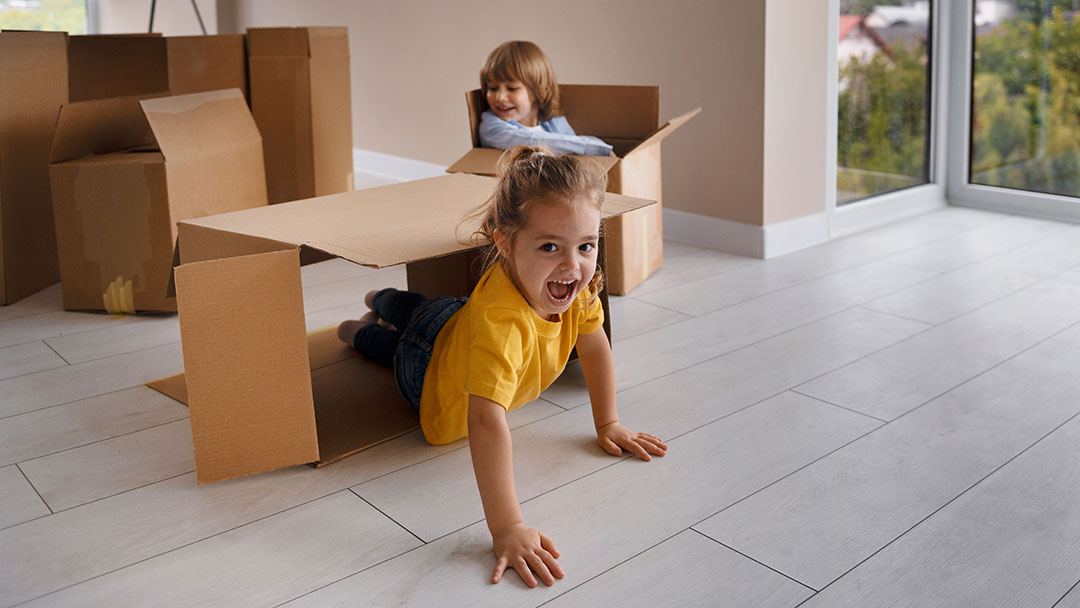
Children playing in moving boxes
4. Choose your suburb with school runs and friend-making in mind
It’s tempting to pick a suburb based on the house you love. But for kids, proximity to other families and an easy school run matters more than square footage. A house that is a fifteen-minute drive from the nearest school and nowhere near other kids their age can leave children isolated in the after-school hours when friendships actually form.
If you are settling on the Sunshine Coast, spend some time exploring things to do with kids in the area before you commit to a suburb. Parks, pools, and community events are where new friendships tend to start, often faster than they do in the classroom.
5. Expect the first school term to be the hardest
Even confident, socially easy kids tend to hit a wall around the four-to-six week mark of a new school. The novelty has worn off; they understand enough about how things work to notice what they don’t have yet. An established friend group, familiarity with the routines, an accent that doesn’t stand out, and homesickness often peaks right here rather than in the first week.
Knowing this in advance helps enormously. A dip in mood or a sudden reluctance to go to school six weeks in is not usually a sign something has gone wrong. It is often just the point where the adjustment gets real. Staying in close contact with teachers during this period, and asking specifically how your child is doing socially rather than just academically, tends to catch problems before they compound.
6. Keep one or two things constant
Total upheaval is disorienting for anyone, but especially for children who have limited control over the bigger decisions being made around them. Where possible, keep something recognisable: a bedtime routine, a favourite food on hand from day one, a stuffed toy that made the trip, even a regular video call scheduled with grandparents or old friends.
These small constants act as anchors. They tell a child’s nervous system that even though the house, the school, and the accent around them have all changed, some things haven’t. And that reassurance does a lot of quiet work in the background.
7. Give yourself the same grace you are giving your kids
Parents often absorb their children’s stress on top of their own. Parents often try to model calm competence while privately fielding a mountain of logistics such as visa conditions, bank accounts, healthcare registration, job hunting, and a new e to learn from scratch. It’s a lot, and pretending otherwise in front of your kids usually is not necessary. Letting them see you find some of it hard, and then work through it, teaches them more about resilience than a permanently cheerful front ever could.
Most families who make this move report the same pattern: the first few months are genuinely difficult, and then, often quite suddenly, they are not. Australia’s outdoor lifestyle, strong sense of community, and family-friendly culture do a lot of the heavy lifting once the early turbulence settles. You just have to get your family through the landing first.
Final thoughts
There is no way to make a big international move completely painless for kids. And it’s worth being honest with yourself about that going in. But the families who come through it best are not the ones who avoided every hard moment; they are the ones who talked early, kept a few things familiar, and gave their kids room to be homesick without rushing them past it.
Give it two terms before you judge how it’s going. That is usually how long it takes for a new school to start feeling like their school, for a new street to start feeling like home, and for the accent, the seasons, and the way weekends work here to stop feeling foreign. Most parents look back and say the hardest part was the anticipation. Once the family actually landed and settled into a rhythm, it came together faster than they expected.