Southeast Queensland may not get much snow, but it does get long, grey afternoons when outdoor plans lose their appeal.
Chunky blanket yarn is useful on those days. It is thick, forgiving and quick to work with, which can help hold a child’s attention. A few balls make a practical addition to a box of wet-weather craft supplies.
Here are five simple family yarn projects, along with the safety and care advice that matters at home.
Safety first, made simple
Before bringing out the yarn and craft supplies, consider two important safety points.
Babies and sleep spaces
Red Nose advises keeping soft or loose items, including blankets, out of a baby’s sleep space. It recommends using a well-fitted safe sleeping bag instead.
The guidance is to keep the sleep space clear for the first 12 months. If you introduce a comforter for an older infant, Red Nose says it should meet Australian safety standards and have no long fabric attachments.
Keep handmade throws for supervised floor play, the lounge room or an older child.
Pom-poms, beads and buttons
The ACCC advises checking age labels and avoiding toys with small parts for children under three. Its downloadable Choke Check tool can help adults identify possible choking hazards.
Store small decorations in a lidded container, supervise children closely and check the floor for loose pieces when you finish.
Yarn basics for families
Blanket yarn is usually a thick, chenille-style yarn. The Craft Yarn Council classifies this weight as number 6, or Super Bulky. Its suggested hook and needle sizes are useful starting points rather than strict rules.
Thick yarn suits beginners because the stitches are easy to see, and a small square can often be completed in one sitting.
A short materials list covers most projects:
- An 8 mm crochet hook or 8 mm knitting needles
- Blunt scissors for children and sharp scissors for adults
- A large, blunt yarn needle for weaving in ends
- Cardboard from a cereal box for looms and pom-pom rings
Bernat Blanket Yarn is one example of this format. A standard 150 g ball contains about 98 m, and the listed fibre content is 100 per cent polyester.
Fibre content affects how a finished project should be washed, so read and keep the ball band. Australian shoppers can consider blanket yarn from Bernat alongside other suitable super bulky yarns, comparing weight, texture and care instructions.
Five projects to make together
1. Finger-knitted cords
No tools are needed. Loop the yarn across the fingers, weave a second pass, then lift each lower loop over the one above it to form a chain.
Early-years guidance from Yarra Ranges Council suggests that older children can finger knit on two, three or four fingers to create bands of different widths. Coil a finished cord into a coaster or stitch it into a headband.
2. Pom-pom garland for a reading nook
Wrap yarn around a cardboard ring or small pom-pom maker, tie the centre tightly and trim the strands into a ball.
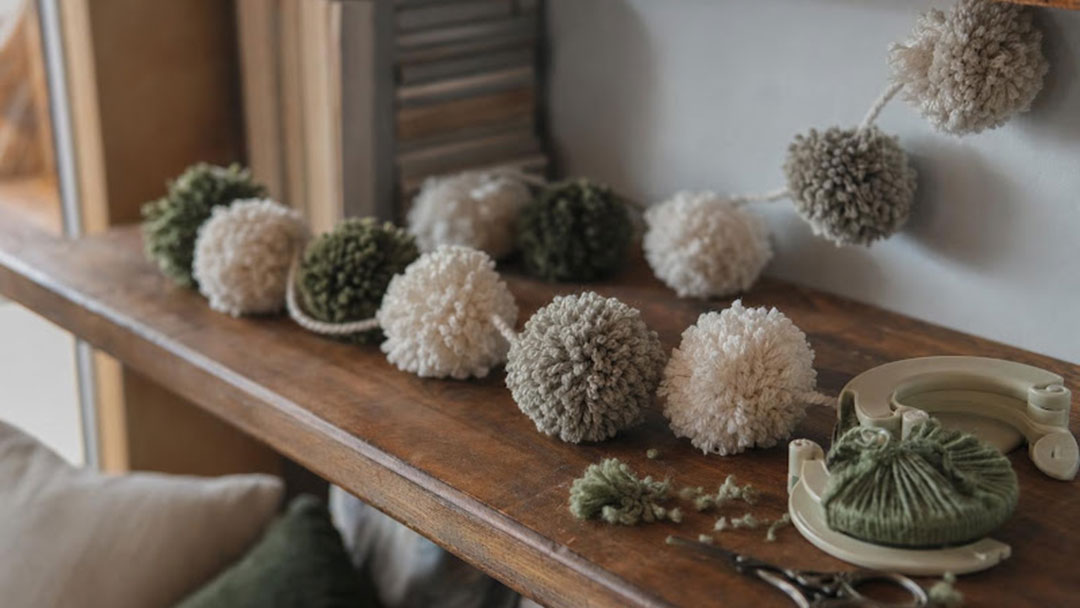
Pom pom garland for a reading nook made from blanket yarn
Thread the finished pom-poms onto a cord and hang the garland along a shelf. Keep loose pom-poms away from children under three and out of infant sleep spaces.
3. Arm-knitted lap throw
Arm knitting uses your arms instead of needles and works well with super bulky yarn.
Cast loops onto one arm, pull new loops through while transferring the work to the other arm, then cast off across the final row. This project is best suited to teens and adults and can be completed over several relaxed sessions.
4. Giant granny-square cushion cover
Use an 8 mm hook to work several rounds of a basic granny square. Make a second square of the same size, join three sides and slide a cushion insert inside before closing the final edge.
Older children can help make the starting chain, count stitch clusters or match the two squares.
5. Cardboard loom squares
Cut evenly spaced notches along two opposite edges of a cereal-box panel. Wind cotton or acrylic yarn between the notches to create the warp threads.
Children can weave chunky yarn over and under the warp while an adult handles trimming and tying. Join several finished squares to make a cushion panel, wall hanging or small family blanket.
Five projects will not carry a whole wet week, so it helps to have a few other rainy day activities ready for the afternoons when nobody wants to pick up a hook.
Care and finishing
Always follow the care instructions on the yarn label. The manufacturer instructions for Bernat Blanket Yarn include machine washing on a delicate cycle and gentle tumble drying. Bleaching, ironing and dry-cleaning are not recommended.
Weave each loose end back through several stitches so it is less likely to work free in the wash. Support a wet project when moving it because the extra weight can stretch the fabric.
If chenille yarn looks flattened after washing, gently shake out the piece and fluff the surface with your fingers as it dries.
When comparing super bulky yarns, check the weight symbol, fibre content and care directions rather than relying on product photos. These details affect the finished texture, durability and washing method.
FAQ
What size hook or needles suit blanket yarn?
An 8 mm hook or pair of needles is a practical starting point for many super bulky yarns. Bernat Blanket Yarn lists an 8 mm tool size for its suggested gauge, but you can adjust the size if your stitches feel too tight or loose.
How can young children help without using needles?
Finger knitting, cardboard-loom weaving and winding yarn for pom-poms can all be done without knitting needles. Keep beads, buttons and loose trims away from children under three, and use the ACCC Choke Check tool if you are unsure whether a part is safe.