
Electricity bills are one of the most frustrating household expenses because they feel entirely out of your control. Prices rise, usage creeps up, and the bill arrives with the same grim reliability every quarter.
Solar power changes that equation in a way that very few other home investments can. The energy your panels generate is yours; you use it first, and what you don’t use you can send back to the grid for a credit. Add battery storage, and the picture improves further: the solar you generate during the day powers the home through the evening, insulating you from peak rates that hit when the grid is under the most pressure.
Companies offering solar battery systems from Volt X Energy are part of a growing market that has made this kind of setup accessible to ordinary Australian families, not just early adopters with deep pockets.
This guide explains how the savings actually work, what realistic numbers look like for different household sizes, and what to consider before making the decision.
How solar actually reduces your bill
There are three ways a solar system reduces your electricity costs, and understanding the differences between them matters for getting the most out of any installation.
Using what you generate
The most valuable outcome is straightforward: when your panels are producing, and you are using electricity in the home, you are drawing from the sun rather than the grid. Every kilowatt-hour you use this way saves you the full retail rate you would have paid, typically between 25 and 40 cents per kilowatt-hour, depending on your retailer and state. This is called self-consumption, and it is where the real savings live.
The practical implication is that running appliances during the day, such as the dishwasher, the washing machine, the pool pump, and the hot water system, makes a noticeable difference to your bill. Timers and smart switches that schedule these loads to run while the sun is shining are inexpensive and genuinely effective. Shifting daytime habits even slightly can increase self-consumption enough to meaningfully change the payback timeline on the system.
Selling what you don’t use
The electricity your panels generate but your household doesn’t use is exported to the grid, and your retailer credits you for it. This is the feed-in tariff. The credit is real, but it is typically lower than the retail rate: most Australian households currently earn somewhere between 6 and 12 cents per kilowatt-hour for exported electricity. That means exporting a unit of solar earns you roughly a quarter of what you would save by using it yourself.
Feed-in credits are a useful bonus, not the core of the savings case. Systems designed to maximise exports rather than self-consumption generally pay back more slowly. The goal is to consume as much of your own generation as possible and export what remains rather than let it go to waste.
Avoiding peak charges with battery storage
A battery stores the solar energy you generated during the day and makes it available in the evening and overnight, when panels are no longer producing, and grid rates are often at their highest. For households on time-of-use electricity plans where the price per kilowatt-hour varies significantly between peak and off-peak periods, a battery can substantially reduce the amount of expensive evening electricity purchased from the grid.
Batteries also provide a degree of protection against price rises and, depending on the system, backup power during grid outages. These are genuine benefits, but they come with an upfront cost that needs to be weighed carefully against the savings they generate.
What the numbers look like for different families
The savings from solar depend on how much electricity your household uses, how much of it you can shift to daytime, your local retail rates, and the size of the system you install. The following examples use conservative assumptions of roughly 4 kilowatt-hours of generation per kilowatt of installed capacity per day and are intended as a guide rather than a precise prediction. Your installer should model your specific address and usage pattern.
A smaller household
A family of three using around 4,500 kilowatt-hours per year with a five-kilowatt system can expect to generate approximately 7,300 kilowatt-hours annually. If around half of that is used in the home, the savings at a retail rate of 30 cents per kilowatt-hour is roughly $1,095 per year from self-consumption alone. The surplus, exported at eight cents per kilowatt-hour, adds up to around $290. A total saving of around $1,400 per year, against a system cost of $5,000 to $7,000 after incentives, produces a payback period of four to five years.
A larger household
A family of five using around 9,000 kilowatt-hours per year with a 6.6-kilowatt system – a common size for larger households generates roughly 9,600 kilowatt-hours annually. With a higher proportion consumed in the home (larger households tend to use more power during the day), the savings from self-consumption rise substantially. Combined savings from self-consumption and feed-in credits can reach $2,000 or more per year, and the payback period compresses accordingly.
The pattern is consistent: households that use more electricity and can shift more of that use to daylight hours get the most out of solar. The system pays for itself faster, and the long-term financial benefit is larger.
Regional differences matter
Retail electricity rates and feed-in tariffs vary considerably across Australia. A household in a capital city paying 35 cents per kilowatt-hour saves more per unit of self-consumed solar than a regional household on a lower tariff. State-specific incentive programs and solar rebate schemes also affect the net cost of installation. Before committing, it is worth running the numbers with a calculator that uses your actual postcode and retailer, the Australian government’s Energy Made Easy comparison tool or your state solar program’s calculator are useful starting points.
The Australian Government’s Energy.gov.au guidance on solar financial benefits explains how self-consumption, feed-in tariffs and batteries interact in plain language, with guidance on how to estimate savings specific to your household’s situation – one of the most reliable independent resources available.
Batteries: When they make sense and when they don’t
Battery storage is the aspect of solar that generates the most questions and the most confusion. The honest answer is that batteries are genuinely valuable for some households and less so for others, and the difference comes down to a handful of specific factors.
Batteries make the strongest financial case for households on time-of-use electricity plans where evening peak rates are significantly higher than off-peak rates. The battery absorbs the day’s solar generation and discharges it during the expensive evening window, reducing the amount of high-cost grid electricity purchased. The greater the spread between peak and off-peak rates, the faster a battery pays for itself.
They also add meaningful value for households that simply cannot shift much consumption to daytime working families, where the home is largely empty during the day, for instance, or households with elderly members or young children who need heating or cooling around the clock regardless of when the sun is shining.
Where batteries are harder to justify financially is in households that already achieve high daytime self-consumption through load shifting, have modest electricity use, or are on flat-rate electricity plans, where the price per kilowatt-hour is the same regardless of when you use it. In these cases, the savings a battery generates may not recover its cost within its useful lifespan.
Batteries also have their own lifecycle to account for. Most residential battery systems are warranted for ten years and will likely need replacement before the panels do. That replacement cost belongs in any honest calculation of the long-term economics. A good installer will walk you through this rather than presenting only the best-case scenario.
Making installation more affordable
Federal incentives
Australia’s Small-scale Technology Certificate scheme reduces the upfront cost of eligible solar installations. The discount is applied at the point of purchase and effectively subsidises the cost based on the system’s expected generation over fifteen years. The value varies with market conditions but can represent a significant reduction in the installed price. Most reputable installers handle the paperwork and pass the discount through directly in their quoted price. If a quote does not include this rebate, ask why.
State programs
Several states operate their own solar incentive programs that sit on top of the federal scheme. Victoria’s Solar Homes program, the Queensland and South Australian solar bonus schemes, and various other state initiatives have collectively helped hundreds of thousands of households access solar at a lower net cost. These programs change over time some close when funding is exhausted, others open new rounds so checking your state government’s energy pages for current availability is worth doing before finalising any quote.
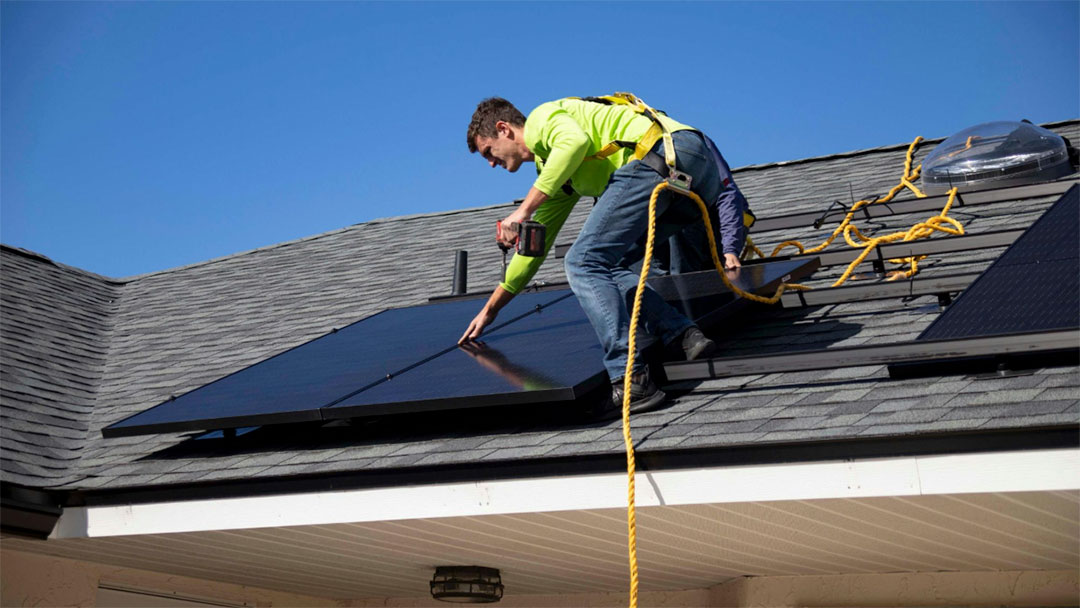
Person installing solar panels on a roof
Options for lower-income households
Upfront cost remains a genuine barrier for many families. Several pathways exist to address this: interest-free or low-interest loan programs through state governments and some councils, community bulk-buy schemes that use collective purchasing to drive down installation costs, and hardship or concession programs through state energy departments for eligible households. The availability and terms of these programs vary by state and change over time. Any installer worth dealing with should be able to point you toward current options relevant to your situation.
Solar for renters and apartment dwellers
Not owning the roof is a common reason people assume solar isn’t an option for them. In practice, there are several paths to accessing solar savings without a suitable rooftop installation.
- Community solar programs allow households to purchase or lease a share of a larger solar installation, typically a local solar farm, and receive a credit on their electricity bill proportional to their share of the generation. Availability varies by location and retailer.
- Virtual net metering models, offered by some retailers, allow solar generated at a shared location to be credited directly to a tenant’s account. This model is more common in some states than others and is worth asking retailers about specifically.
- Body corporate or strata-managed installations are increasingly common in apartment buildings, where a shared rooftop system generates electricity that is credited across the building’s common areas and sometimes to individual units.
- For renters in houses, it is worth raising the idea directly with a landlord. Solar adds value to the property and reduces energy costs for both parties, and some state tenancy frameworks now support these conversations more formally.
None of these options delivers quite the same financial return as owning a rooftop system, but they are genuine alternatives for households in situations where rooftop solar simply is not available.
The long-term picture
Solar panels from reputable manufacturers carry performance warranties of twenty-five years, and many systems installed in the early days of the Australian rooftop solar boom are still producing well. The panels themselves are the most durable component of the system. What needs more attention over a system’s life are the inverter and, where applicable, the battery.
Inverters, the box that converts the DC electricity your panels generate into the AC electricity your home uses, typically carry warranties of ten to fifteen years and will generally need replacement once during a system’s life. This is a known cost, typically a few hundred to a few thousand dollars depending on system size, and belongs in any genuine long-term calculation.
Maintenance is minimal for most Australian rooftop systems. Panels are self-cleaning in areas with regular rainfall; in drier regions or where trees or birds are a factor, an occasional clean improves performance. Monitoring your system’s output through the inverter’s app or a web portal is the most valuable maintenance habit it lets you notice any underperformance quickly and address it before a billing cycle reveals the problem.
The single most important long-term protection is choosing a reputable installer with a solid workmanship warranty and a business that will still be operating when you need to call them. The Australian solar industry has seen a number of companies exit the market, leaving customers with warranty claims and no one to honour them. The Clean Energy Council’s accredited installer list is a sensible starting point.
The questions families ask most often
What if my roof doesn’t face north?
North-facing roofs capture the most solar in Australia, but east and west-facing installations still generate meaningfully and can suit households well, particularly if you use more electricity in the mornings or evenings, respectively. A good installer will model your specific roof orientation and tell you honestly what generation to expect. Only roofs that are heavily shaded or structurally unsuitable should be ruled out for solar entirely.
How long before it pays for itself?
For most Australian households, the payback period on a properly sized rooftop system sits between four and eight years. The range reflects the variation in household electricity use, retail rates, system costs, and the extent of daytime consumption achievable. After payback, the electricity those panels generate is effectively free for the system’s remaining life.
Do I need a battery?
Not necessarily, and not as a first priority. For many households, the strongest return comes from maximising solar self-consumption without a battery through load-shifting, timers, and behavioural changes before adding storage. A battery becomes more compelling once those simpler measures are in place, and there is still significant evening grid consumption to address.
Is solar worth it with rising feed-in rates dropping?
Feed-in tariffs have fallen over the years as grid solar penetration has increased, and this trend is likely to continue. This makes self-consumption more important, not less. A well-sized system where the household uses most of what it generates is substantially less dependent on feed-in credit revenue than older systems designed around high export rates. The economics still stack up strongly for most households; they just require a different approach to system design and usage habits.
The Clean Energy Council’s consumer guide to buying household solar covers what to look for in a quote, how to verify installer accreditation, what questions to ask before signing any contract, and how to understand performance projections the most comprehensive independent consumer resource available for Australian households comparing solar options.
How to get started
The process of evaluating solar does not need to be complicated. A few clear steps cover most of what you need to know before making a decision.
- Gather twelve months of electricity bills and note your average quarterly usage in kilowatt-hours. This single piece of information is the starting point for any installer’s modelling.
- Use a postcode-specific solar savings calculator, the government’s Energy Made Easy tool or your state solar program’s calculator to get a rough sense of what a system of different sizes might save at your address.
- Get at least three written quotes from Clean Energy Council-accredited installers. Each quote should specify the panel brand and model, inverter brand and warranty, expected annual generation, assumed self-consumption percentage, retail rate and feed-in tariff used in the savings projection, and the installer’s workmanship warranty.
- Compare the quotes on a like-for-like basis: total cost after all incentives, expected annual savings, implied payback period, and the strength of the warranties on offer.
- Ask each installer to explain their assumptions clearly. If the projected savings rely on a self-consumption rate that seems unrealistic for your household, or a retail rate higher than you currently pay, the payback period they are quoting will not materialise.
Solar is a long-term investment in the home, and the decision deserves the same care you would give any significant financial commitment. The families who get the most out of it are the ones who understand what they are buying, choose their installer carefully, and approach their usage habits with the same attention they give to the installation itself.
Related Reads
How to save energy around the home
Who is the biggest energy waster in your household?