
Aquaphobia grips more people than you’d think. Children, teenagers, adults well into their fifties, the fear of water doesn’t discriminate by age. It freezes the body, quickens the breath, and turns a simple swimming pool into a source of dread. Yet swimming remains one of the most valuable life skills anyone can develop.
The most reliable path to overcoming this fear? Working with a qualified swimming teacher. A professional brings structure, safety, and a calm presence that no YouTube tutorial can replicate. In 2026, swim schools across Australia offer methods tailored to every anxiety level, from mild unease to full-blown panic at the sight of deep water.
This article covers three proven approaches: guided familiarisation with water, building flotation confidence through supported exercises, and learning basic strokes in a stress-free environment. Each method works best under the watchful eye of an experienced instructor.
Why learning to swim with an instructor is the most effective method to overcome the fear of water
A qualified teacher transforms fear into progress by reading your anxiety and adjusting every exercise in real time. When you learn to swim with a teacher, you gain access to a controlled environment where safety comes first, always. That single factor changes everything.
Here’s what separates a certified instructor from a well-meaning friend or relative:
| Certified instructor | Friend or family member | |
|---|---|---|
| Technical knowledge | Formal training in stroke mechanics and rescue techniques | Limited or self-taught |
| Emotional approach | Professional patience, zero judgment | May project frustration or personal expectations |
| Progression plan | Structured, milestone-based curriculum | Ad hoc, often skipping steps |
| Safety skills | First aid certified, trained for aquatic emergencies | Rarely qualified |
An anxious adult who practises alone often reinforces bad habits or avoids the very exercises that build confidence. A teacher spots tension in your shoulders before you even notice it yourself. They know when to push gently and when to pause.
The difference shows in results. Adults with aquaphobia who train under professional guidance consistently report feeling comfortable in the water within weeks, not months. That structured progression, moving from one mastered skill to the next, simply doesn’t happen without expert oversight.
Method 1: Gradual familiarisation with water guided by a teacher
Gradual exposure works because it respects your nervous system. Instead of jumping in (literally), a teacher walks you through a sequence: observe the pool, touch the water, then enter at your own pace. No step gets skipped. The instructor sets the rhythm, and you control the speed.
Trust builds from the very first session. Your teacher explains what will happen before it happens, eliminating surprises that trigger panic.
First encounters with water: from the edge of the pool to the shallow end
The process starts dry. You sit on the pool edge, feet dangling in the water, getting used to the temperature and the sensation. Your teacher stands in the shallow end, close enough to reach you.
Next come breathing exercises on land. Slow inhales through the nose, long exhales through the mouth. You repeat these while splashing water on your arms and face. The goal? Associating water contact with calm, controlled breathing.
When you descend the steps into the shallow end, the teacher offers a hand. Nobody forces immersion. You stand waist-deep and simply exist in the water until your heartbeat settles.
Learning how to put your face in water without panicking
Blowing bubbles sounds childish. It works anyway. You lower your mouth to the surface and exhale gently, watching the bubbles rise. Then you try it through your nose. These small acts teach your brain that water near your face doesn’t mean danger.
Over several sessions, you progress to dipping your entire face, then your head. Your teacher talks you through each attempt, offering verbal anchors like “breathe out slowly, I’m right here.” That voice becomes a safety net.
The panic reflex, that sudden urge to jerk your head up, fades with repetition. Controlled exhalation gives your body something to do instead of panicking. You replace fear with a physical routine.
Method 2: Building buoyancy and balance with supervised exercises
Your body naturally floats. Most aquaphobic swimmers don’t believe this until they experience it firsthand. A teacher demystifies the physics: lungs full of air act like built-in buoys. Understanding why you float removes one of the deepest fears, the conviction that you’ll sink like a stone.
Front and back flotation with support from the instructor
Your instructor places a hand under your back or belly while you lie in the water. That single point of contact feels like a lifeline. You focus on relaxing your neck and letting your legs drift upward.
Session after session, the teacher reduces physical support. First a full palm, then fingertips, then hovering just below without touching. You don’t always notice the change, and that’s the point. Foam noodles and kickboards serve as intermediate support tools, bridging the gap between assisted and independent floating.
The moment you realise you’ve been floating alone for ten seconds? That rewires something deep. Confidence replaces doubt.
Leg kicking exercises and initial movements
Grip the pool wall and kick. Straight legs, relaxed ankles, steady rhythm. This exercise builds propulsion without requiring you to let go of safety.
Once kicking feels natural, you grab a kickboard and glide forward. Two metres at first. Then five. Your teacher positions themselves a little further away each time, creating a growing zone of autonomy. You’re swimming toward someone you trust, which makes the distance feel manageable rather than terrifying.
Method 3: Learn the basic swimming strokes with confidence
Moving from floating to actual swimming marks a pivotal shift. Your teacher supervises this transition closely, introducing arm movements only after flotation and kicking feel automatic. Rushing this stage breeds frustration.
Backstroke: the ideal swimming stroke for anxious beginners
Backstroke keeps your face above water at all times. For anxious swimmers, that detail matters enormously. You breathe freely, see the ceiling, and maintain a sense of spatial awareness.
The technique stays simple:
- Kick steadily with straight legs
- Alternate arm movements, reaching back over your head one arm at a time
- Keep your hips high and your chin slightly tucked
Your teacher supports your neck during the first attempts, then gradually steps back. Backstroke builds confidence faster than any other stroke because it removes the breathing challenge entirely.
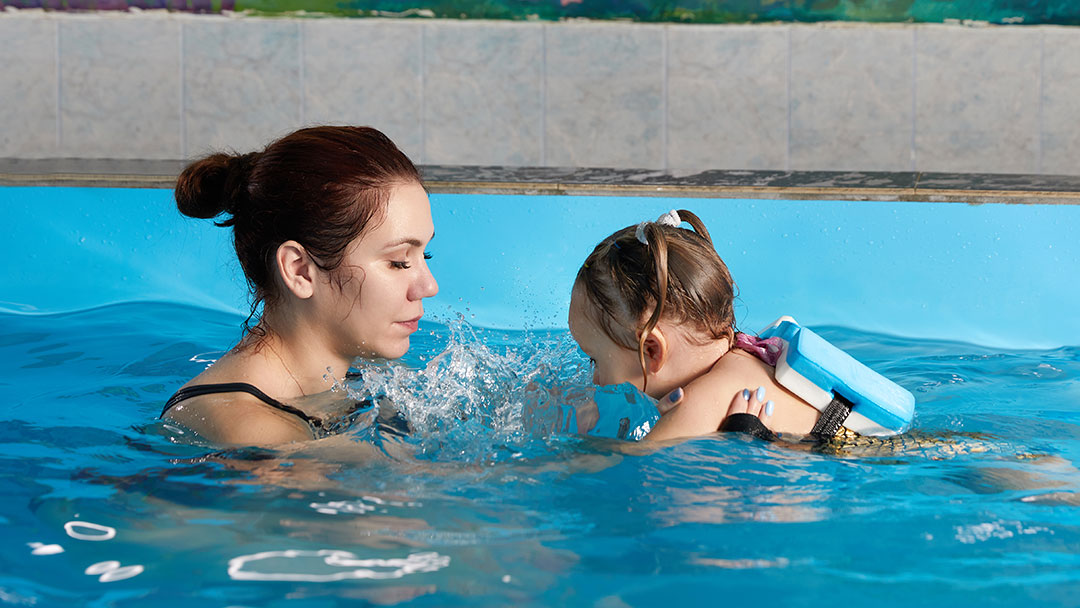
Swim instructor helps young child learn to swim in pool
Introduction to freestyle and breaststroke swimming with an instructor
Crawl and breaststroke demand coordination between arms, legs, and breathing. Your teacher breaks each movement into isolated components. You practise the arm pull standing in shallow water. Then the kick while holding the wall. Only after mastering each piece do you combine them.
Breathing coordination trips up most beginners. In crawl, you turn your head sideways to inhale, a motion that feels unnatural at first. In breaststroke, you lift your face forward. Your instructor demonstrates, then watches you replicate the timing. Repetition builds muscle memory, and patience keeps frustration at bay.
Expect plenty of water up your nose in the early days. That’s normal. Your teacher will remind you to exhale underwater before turning to breathe.
How to choose the right swimming instructor when you’re afraid of the water?
Not every swim teacher has experience with aquaphobic students. Look for specific qualifications and a gentle teaching approach before booking your first lesson.
Key questions to ask before signing up:
- Do you hold a recognised certification (such as AUSTSWIM or equivalent)?
- Have you worked with anxious or phobic swimmers before?
- What does a typical first lesson look like?
- How large are your group classes?
- Can I try a single session before committing?
Private lessons offer undivided attention and a pace entirely tailored to you. Small group sessions (three to five students) can also help, because seeing others face the same fear creates solidarity. Choose based on your comfort level, not just budget.
Prioritise a trial session or phone call. The relationship with your teacher matters as much as their qualifications. You need someone whose voice calms you, not someone who makes you feel rushed.
Practical tips for making progress between sessions with your teacher
Progress doesn’t stop when you leave the pool. Simple daily practices accelerate your confidence between lessons.
Breathing exercises take five minutes. Sit comfortably, inhale for four counts, hold for four, exhale for six. This technique lowers baseline anxiety and prepares your nervous system for the next session. Practise it every morning.
Mental visualisation helps too. Close your eyes and picture yourself floating calmly, kicking across the pool, breathing without panic. Your brain struggles to distinguish vividly imagined scenarios from real ones, so visualisation primes your body for success.
Aim for one to two lessons per week. Regularity beats intensity. A weekly rhythm keeps skills fresh without overwhelming your nervous system. Keep a short journal after each session, noting what felt easier, what challenged you, and what surprised you. Reading back through those entries after a month reveals progress you might otherwise overlook.
And one final thing: stop comparing. The swimmer in the next lane learned in different circumstances, with a different body and a different story. Your journey belongs to you alone.
FAQ
At what age can someone who is aquaphobic learn to swim with an instructor?
No age limit exists. Specialised teachers welcome adults of every generation, from university students to retirees. Methods adapt to both age and anxiety level, so a 60-year-old beginner receives a completely different approach than a nervous seven-year-old.
How many lessons does it typically take to overcome a fear of water?
Most aquaphobic swimmers need between 10 and 20 sessions to feel genuinely comfortable. Attending one to two classes per week keeps momentum strong and shortens the overall timeline. Severe phobias may require additional sessions, but steady attendance consistently delivers results.
Are private lessons more effective than group lessons for anxious people?
Private lessons give you the teacher’s full attention and a rhythm shaped entirely around your needs. Group classes in small sizes (three to five people) offer a different advantage: shared experience. Seeing others face the same fear can feel deeply reassuring. Many swimmers start with private sessions and transition to small groups once their confidence grows.