
After a few seasons on a P&F committee, most parents notice the same pattern. Every school event has a moment on the day where something printed (or not printed) decides whether things run smoothly or unravel in the last hour. Usually it is the parking signs, the volunteer name tags, or the toilet directions that nobody added to the list back at the planning meeting four weeks earlier.
This guide pulls together what to print for trivia nights, fetes, school discos and Mother’s Day stalls, what to skip, and the mistakes Australian P&F committees keep making. It is written for parent volunteers who have ended up running the printing brief and would prefer not to do it the hard way twice.
The four jobs printed material has to do
Every school event needs print in four categories. If your list is missing one, the event will feel chaotic on the day.
Awareness. Flyers home in school bags, posters for the notice board, a notice in the newsletter, social tiles. This is where most committees focus, because it is the bit people see in the weeks before.
- Wayfinding. On-the-day signage. Parking arrows, “entrance this way”, toilet directions, “first aid”, “lost children meet here”. This is the bit most committees forget and the bit that decides whether parents have a relaxed afternoon or a stressful one.
- Transaction. Raffle books, ticket stubs, price signs, “we accept cash and tap” signs, QR codes for cashless donations, stall numbers. If money cannot change hands quickly, you raise less of it.
- Recognition. Sponsor recognition at the entrance, thank-you cards for businesses that donated prizes, certificates for the kids who helped run stalls. This is where next year’s sponsors get won or lost.
If you have only printed flyers and a couple of posters, you have covered awareness and forgotten the other three. That is usually where the post-event committee meeting goes off the rails.
Flyers home in school bags: still the highest-converting piece
The take-home flyer remains the most effective awareness piece a P&F has. Parents read what comes home in the bag in a way they will not read the newsletter. For flyer printing it is worth getting a few things right.
- DL size, one third of A4, wins for school bags. It folds in fewer times, gets less mangled, and fits comfortably in a take-home folder.
- Print on slightly heavier stock, 150gsm or 170gsm, so the flyer survives the school bag. Standard 100gsm comes home crumpled. Parents skim and bin crumpled.
- Single-sided is fine for short events. Double-sided is worth it for fetes where you can put a stall map on the reverse.
Always print 10 per cent more than you think you need. Kids break up sets of three for their best friends. That is just how the bag drop works.
The pull-up banner that earns its keep year after year
The single highest-leverage print investment a P&F can make is a reusable pull-up banner with school colours and a generic message. “School Fete”, “Welcome”, “Trivia Night” or the school crest are versions that last five or six years in a cupboard between events and remove the need for fresh signage every twelve months.
Two practical notes.
- Order more than one. A set of three (entrance, photo wall, presentation or raffle area) handles most events and runs about the cost of a single oversized indoor banner. The same set works for open days, sport carnivals, presentation evenings and assemblies.
- Print sponsor logos on a separate strip rather than trying to Velcro panels onto the main banner. The Velcro approach falls apart by the second event and looks shabby. A sponsor strip reprinted each year is cheap and looks intentional.
Programs, tickets and the trivia night
For trivia nights and quiz events, a printed program with the round structure, answer sheets and the bar menu is worth doing properly. It is the difference between a tidy evening and a host shouting over a hundred parents at the back of the hall.
Printed entry tickets carry their weight too. They make the door easier to run, give your sponsor a place to land at the bottom of the ticket, and the unused stubs make for a clean raffle. Postcard-stock tickets are cheap and feel substantial enough that parents do not lose them between buying and turning up.
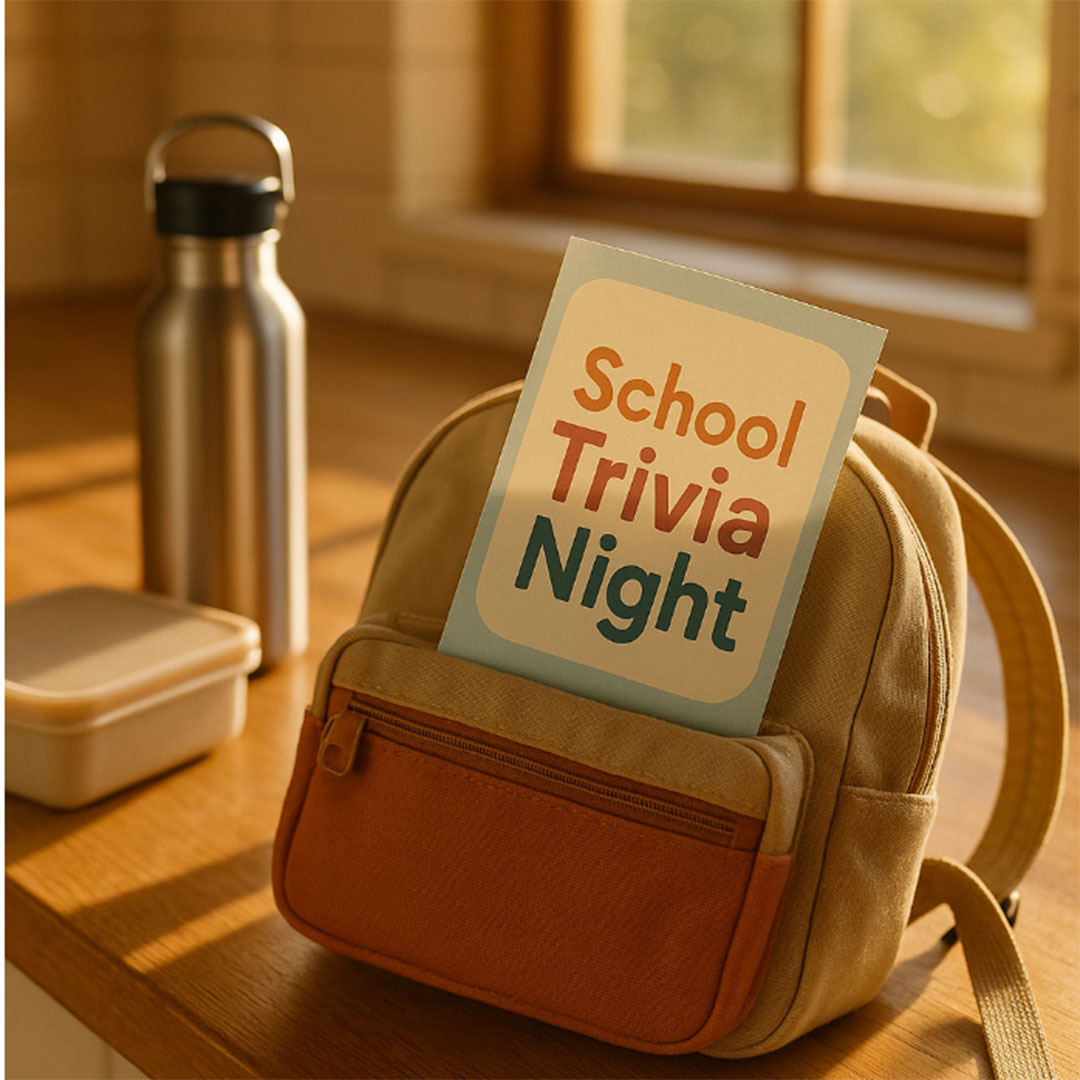
Tan backpack on a wooden table with a flyer reading ‘School Trivia Night’ tucked into the front pocket.
The signs nobody puts on the list
The committees that run smooth events have a wayfinding list that goes beyond the obvious. Worth ordering for any event with more than 200 attendees:
- Toilet signage with an arrow, not just a sign on the door
- Parking arrows for the overflow grass area
- “Pay here” signs with the EFTPOS and QR code logos on them
- “Cash only” signs where they apply
- Stall number signs (1, 2, 3) on coreflute, reusable for years
- A “lost children meet at the office” sign at the main entrance
- A program board for the bigger events: bouncy castle session times, dance performance times, raffle draw time
None of this is expensive. A dozen coreflute signs with stakes is cheaper than reprinting an oversized banner. The committees that have them look organised. The ones that do not end up writing on butcher’s paper with a Sharpie at 7am on the day.
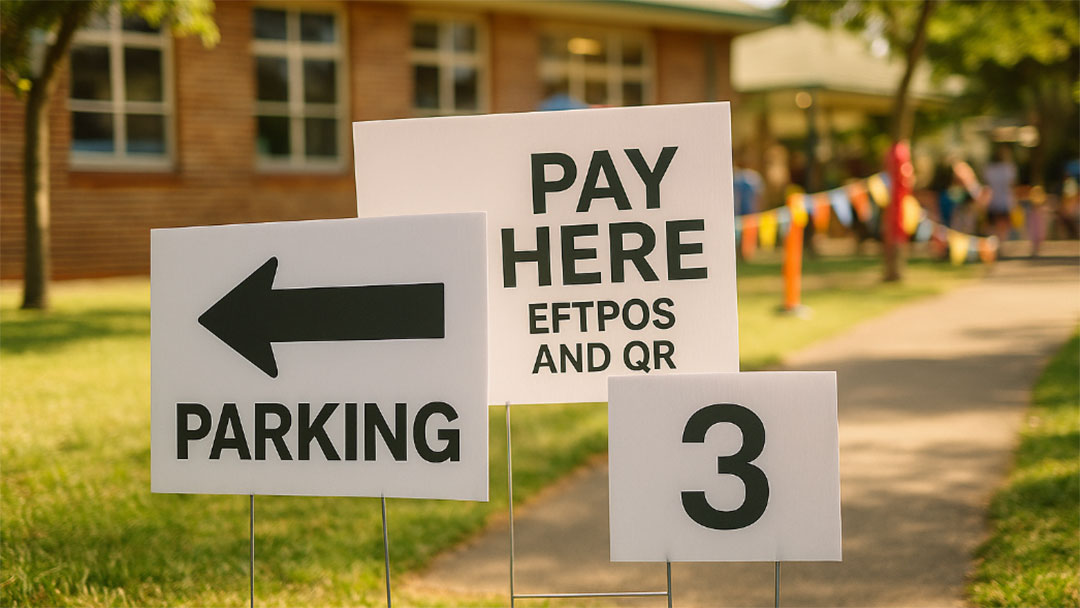
Collection of corflute signs for a school fete
Sponsor recognition: do not skip the thank-you postcard
Local businesses that donate a raffle prize, sponsor a stall or shout a band remember whether you said thank you properly. A printed postcard with a handwritten note from the principal or P&F president, dropped into the business a week after the event, secures the relationship for next year. Email thank-yous get lost. Printed cards on a counter or notice board do not.
Twenty or thirty postcards is a tiny line item that returns a disproportionate amount of goodwill. It is also the easiest part of the printing budget to defend at the next P&F meeting.
The four-week sprint
Most committees underestimate how long printing takes when artwork still needs finalising. A clean run looks like this.
- Four weeks out. Lock the date, sponsor list and artwork brief. Send rough quantities to your printer for a quote. Most printers will turn around a quote and a turnaround the same day if the brief is clear.
- Three weeks out. Sign off artwork. This is the step that always slips, because artwork goes around three or four people before someone hits approve. Pad the timeline here.
- Two weeks out. Production. Flyers, programs and the pull-up banner all get printed and delivered.
- Event week. Wayfinding signage and last-minute pieces, anything that depends on final stall layouts or scheduling. A good printer can turn these around in two or three days if you have kept them in the loop.
The committees that get into trouble are the ones who decide on stall layouts the week of the event, then realise on Wednesday they have no signs. Build in a buffer for the wayfinding pieces, not just the headline banner.
What committees underspend on, and what they overspend on
After a few seasons of these events, the same pattern shows up.
Committees consistently underspend on wayfinding and reusable banners. These are the highest-leverage pieces. A pull-up banner does five years of work for one event’s budget.
Committees consistently overspend on novelty items: printed bags, branded balloons, custom water bottles for volunteers. None of it drives attendance. If you have discretionary print budget, put it into a better entrance banner and a properly printed program for the trivia night, not into another batch of branded notepads nobody asked for.
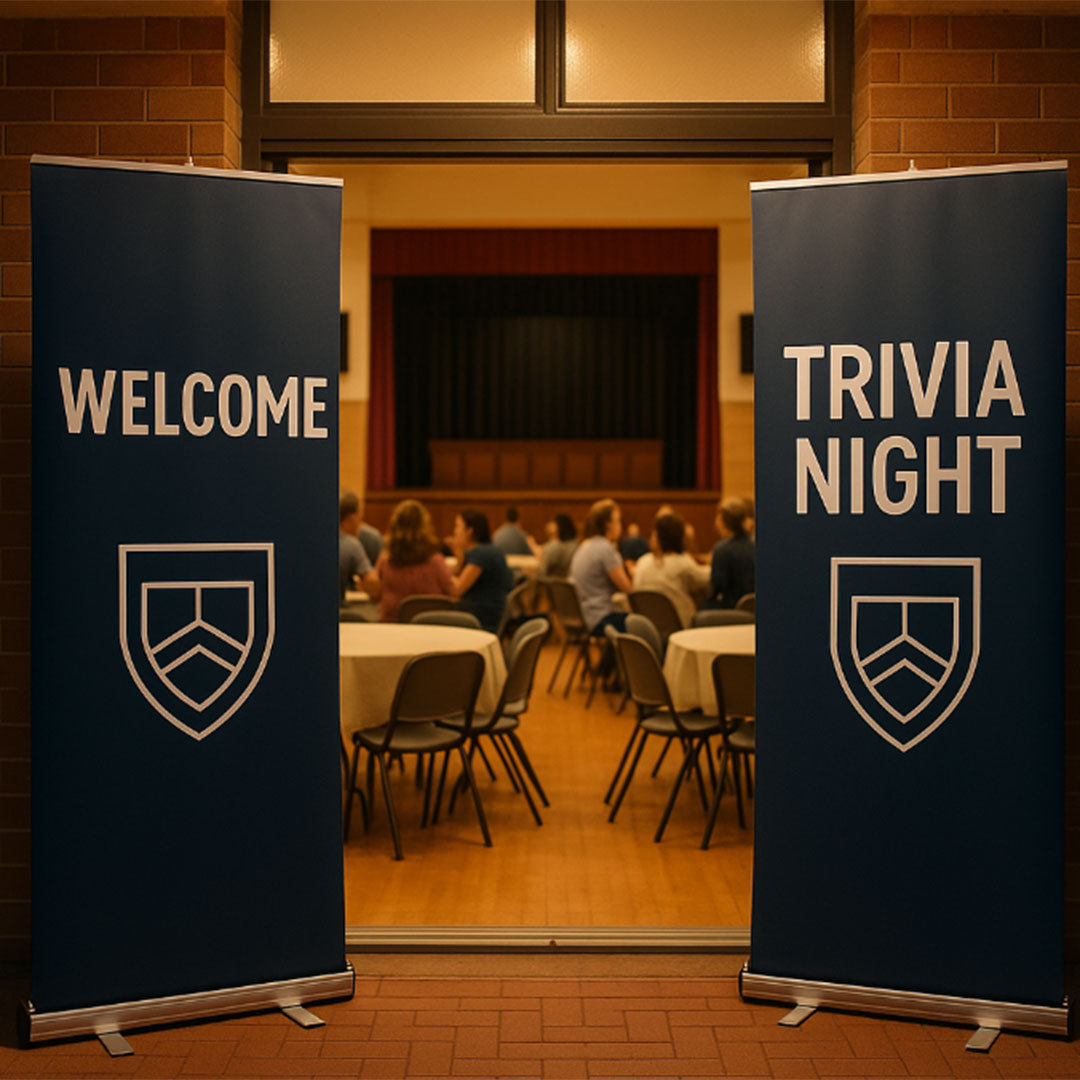
Pull-up banners at a school trivia night
A short final checklist
Before you sign off the print brief, run through these.
- Are the dimensions of any banner sized to where it will stand or hang
- Is there a wayfinding list, not just an awareness list
- Is the sponsor recognition piece separate so the main banner can be reused
- Is there a “pay here” sign for every place money changes hands
- Has the artwork been seen by the principal, the P&F president and the sponsor coordinator before going to print
- Is the turnaround real, or the printer’s optimistic number
If all six are yes, the event will look organised. Which is most of the work.
About the author
Elmo Stoop runs Space Print, an Australian commercial printer that works with schools, community groups and small businesses on flyers, pull-up banners, postcards and printed materials for fundraising events.