Key takeaways
- Six checks cover the essentials: size and age fit, stability, the sliding surface, steps and handrails, space and landing, and materials and care.
- A slide that suits your child’s age and height is easier to use and safer to play on.
- Where you put the slide, and what is underneath it, matter as much as the slide itself.
- Follow the maker’s guidance, supervise play and check the slide regularly.
Introduction
A slide is one of those toys children never tire of. They climb, they slide, they run around and do it all again. It is simple, active play that suits toddlers and primary school children alike, and it is often the first piece of outdoor equipment a family buys.
Because slides come in many sizes and styles, it helps to know what to look for before you spend. This checklist covers six things to check, so you can choose a slide that fits your child, your space and your budget.
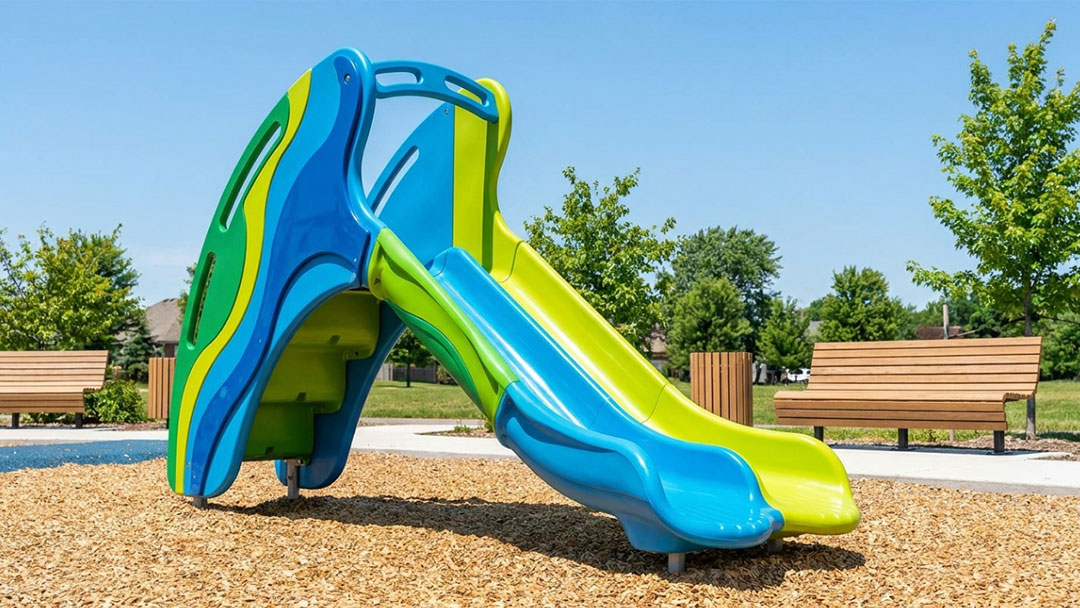
Plastic kids slide in a park with benches and trees beyond.
How to use this kids slide checklist
A kids slide can be a standalone slide, a slide with a climbing frame or part of a larger play set. The checks below apply to all of them, though some will matter more depending on the type.
Read through each check before you shop, and use the list again when you are looking at a slide in person or online. If you cannot answer a question from the product information, ask the retailer.
Check one: Size and age fit
Start with your child. A slide should suit their age, height and confidence.
Toddlers do best on a low slide with a gentle slope, a wide base and a small, easy climb. Primary school children often want more height and a longer slide. Choosing a slide that is too big for a young child can make climbing and sliding harder and less safe, while one that is too small may be outgrown quickly.
Check the manufacturer’s guidance on age, height and weight, and follow it. These limits exist for safety, and they also help you pick a slide that your child will enjoy for longer.
If you have children of different ages, think about whether one slide can suit both, or whether you need separate options.
Check two: Stability and frame
A slide should stay put when children use it. Check the base and frame carefully.
Look for a wide, solid base that does not rock or wobble. The legs or supports should sit firmly on the ground, and the frame should feel strong when you push on it. Joints and fixings should be tight, with no gaps or loose parts.
For larger slides, check whether the maker recommends anchoring the slide into the ground, and follow the instructions. Heavier children and active play put more force on the frame, so build quality matters.
A stable slide is also easier to assemble correctly. Read the instructions before you buy, so you know how much time and help you will need.
Check three: The sliding surface
The slide itself is the part children use most, so look at it closely.
The surface should be smooth, with no cracks, rough patches or sharp edges. Side rails should be high enough to keep children from slipping off, and the edges should be rounded. The exit at the bottom should be low and gentle, so children can step off easily.
Think about heat, too. In summer, some surfaces can become warm in direct sun, so choose a spot with some shade and check the surface before use. Ask the retailer how the slide material behaves in hot weather.
Check the width and shape. A wider slide is more comfortable for older children, while a narrower one suits toddlers. Make sure the slope is gentle enough for your child’s confidence.
Check four: Steps, ladders and handrails
Getting up is as important as coming down, so check the way up.
Steps and ladders should be solid, evenly spaced and non-slip. Look for a design that suits your child’s size, with rungs or steps that are easy to climb. Wider steps are easier for toddlers.
Handrails give children something to hold as they climb, and they help them keep their balance at the top. They should be sturdy and the right height for your child, with no gaps where heads or limbs could get stuck. The Lifespan Kids website lists safety rails, wide steps and smooth edges among the features to look for.
If the slide has a platform at the top, check that it is large enough for children to sit and turn safely, and that it has barriers or rails around it.
Check five: Space and landing
Where you put the slide affects how safe it is.
Choose a flat, level area with plenty of room. Keep the slide away from fences, walls, trees and garden beds, and leave a clear space at the bottom so children can step off without running into anything. Check for overhead hazards, such as branches.
The surface underneath matters too. Soft ground, such as lawn, is better than concrete or paving, and soft-fall materials such as bark or rubber matting add extra protection. Avoid hard surfaces and rocks.
Position the slide where you can see it from the house, so supervision is easy. If you plan to use it indoors, clear the area of furniture and hard objects, and place it on a non-slip surface.
Check six: Materials and care
The materials affect how long the slide lasts and how much care it needs.
Many kids’ slides are made from plastic, which is light, easy to clean and suited to outdoor use. Others combine plastic with metal or timber frames. Whatever the material, look for parts designed for outdoor use and the Australian climate, with finishes that resist sun, rain and rust.
Lifespan Kids describes its slides as UV-stabilised moulded plastic designed for outdoor play, and lists standalone slides, slide attachments and climb-and-slide sets.
Think about how you will store the slide. Some can be folded or taken apart, which helps in small yards. Others stay in place all year.
Plan to check the slide regularly. Look over the frame, fixings, steps and sliding surface for wear, cracks and loose parts, and clean it with mild soap and water. Replace damaged parts promptly, and do not use the slide until it is repaired.
Extra points worth a look
A few extra details can make a difference.
Check whether the slide can be used with other equipment, such as a climbing frame or a cubby house. Look at the colours and design, since children often enjoy a slide that suits their taste. Think about whether the slide can be moved easily when you want to mow the lawn.
House rules for safe slide play
Clear rules help children enjoy the slide safely.
One child on the slide at a time is a simple rule. Children should sit and slide feet first, and they should move away from the bottom quickly so the next child does not land on them. No climbing up the slide, and no sliding head first.
Adults should supervise younger children, and check in regularly with older ones. Avoid use when the surface is wet or very hot. Remove scarves and loose clothing that could catch.
Mistakes to avoid
The most common mistake is choosing a slide that is too big for the child. Always match the size to their age and height.
Another is ignoring the landing area. A good slide on a hard surface is still risky.
Finally, do not rely on the slide to replace supervision. Even the safest slide needs an adult nearby.
Choosing with confidence
Work through the six checks: size and age fit, stability, the sliding surface, steps and handrails, space and landing, and materials and care. Match the slide to your child, set it up on level ground with a soft surface and check it regularly. With the right slide and a few simple rules, your children can enjoy years of safe, active play in the backyard.
Frequently asked questions
What size kids slide do I need?
Choose a slide that suits your child’s age, height and confidence. Toddlers do best on a low, gentle slide, while older children enjoy more height. Follow the manufacturer’s guidance.
Where should I put a kids slide?
Place it on flat, level ground with plenty of clear space around it and a soft surface at the bottom. Keep it away from fences and trees, and where you can supervise.
How do I keep a kids slide safe?
Choose a stable slide, follow the maker’s guidance, set simple rules, supervise play and check the slide regularly for wear or loose parts.
Related Reads
5 Ways to Create a Screen-Free Outdoor Oasis in Your Backyard
Best Cubby Houses for Small and Large Backyards in 2026