Almost every detail at Shapland Swim School has been shaped by one simple question: what helps children learn best? From classes capped at just three children and purpose-built multi-depth pools to focused 20-minute lessons and warm 32°C magnesium mineral water, the Shapland approach looks different from the traditional learn-to-swim model — and that is entirely intentional.
At the centre of that approach is Chris Shapland, the third generation of his family to help shape the Shapland method. The family’s involvement in swimming education began in 1938 with Chris’s grandfather, while his father later opened the first boutique Shapland Swim School in 1973. Chris took over the family business in 1980 and has spent the decades since refining and developing the program, drawing on hands-on experience and a deep understanding of how children learn in the water.
It is an approach that’s had more than eight decades to be observed, tested, refined and perfected. Today, across 16 schools in Queensland, that same philosophy still underpins every lesson. Talk to Chris and it quickly becomes clear that the class sizes, pool design, lesson length and even the water itself are not simply features designed to make Shapland different. Each has evolved with purpose, shaped by generations of watching how children learn, where they struggle and what helps them build genuine confidence in the water.
Built on decades, not trends
“I think the length of time we’ve been in the industry gives us a huge advantage because we’ve had decades to think it through and to simplify,” Chris says. “It’s got to be simple. Anything really complicated just inhibits your creativity as a teacher.”
That philosophy underpins almost every decision at Shapland. Rather than adopting the “station teaching” model used by many larger swim schools — where an instructor stays in one spot and works through a fixed script of skills with a group — Shapland trains its teachers in a flexible system that can be adapted to the child in front of them.
“All children learn differently,” Chris explains. “For some children words work better; for others examples work better. We don’t restrict instructors with standing in one spot with predetermined words and phrases. It also means our teachers are happier and have far more job satisfaction.”
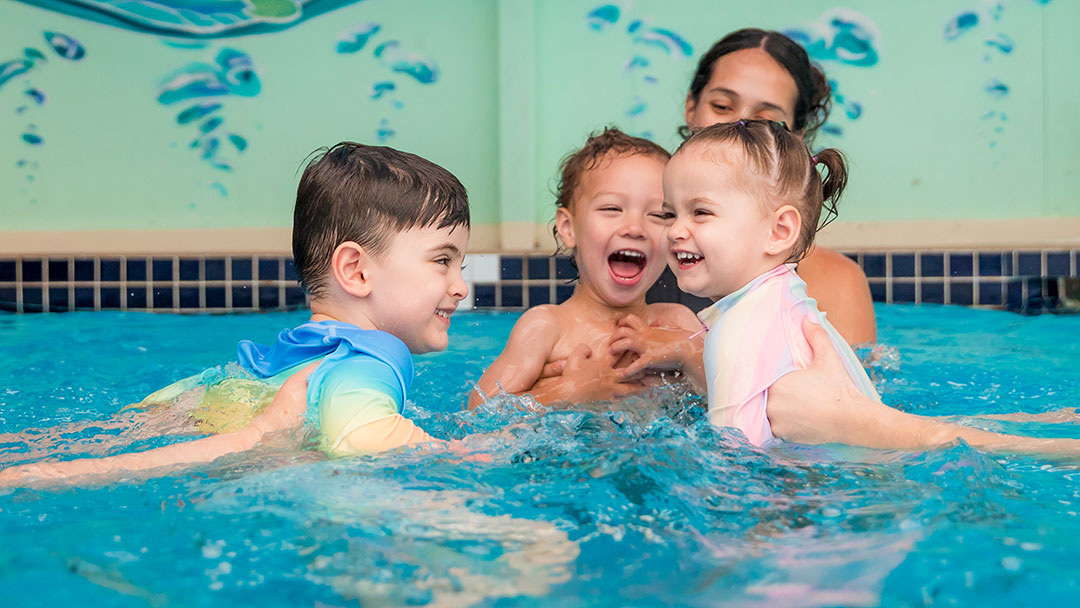
Happy kids in the pool at Shaplands Swim School
Small class size matters
Perhaps the most obvious way Shapland sets itself apart is class size. Every lesson is capped at a maximum of three children — a number arrived at not by accident, but by years of testing what actually gives children the best combination of individual attention, active swimming time and the social benefit of learning alongside peers.
“Our class sizes are a maximum of three, which is extremely important for children to really get that individualised teaching; there’s no waiting around for children to take turns,” Chris says.
With just two or three classes running at any one time, the pool is always a quiet, low-stimulation environment. Chris believes this matters far more than people often realise, particularly for children who are anxious, easily distracted or simply overwhelmed by the noise of a typical aquatic centre.
Pools designed to teach
The pools themselves are engineered as teaching tools, not just containers for water. Rather than a single shallow end and a single deep end, Shapland’s purpose-built pools feature multiple depths — sometimes eight or more — allowing a teacher to work with a child at precisely the depth that suits their height, confidence and skill level.
“We have one of the very rare specialised teaching pools in the industry,” Chris says. “These gradual depths allow for progressive learning in a moderated way where children can gain confidence. We can introduce a child by increments of up to 50mm if necessary.”
The water is kept at a warm 32°C year-round and uses magnesium mineral water, chosen for being gentler on children’s eyes, skin and hair than standard chlorinated pools. It’s a small detail with an outsized effect: a child who isn’t cold, itchy or uncomfortable is a child who can actually concentrate on learning.
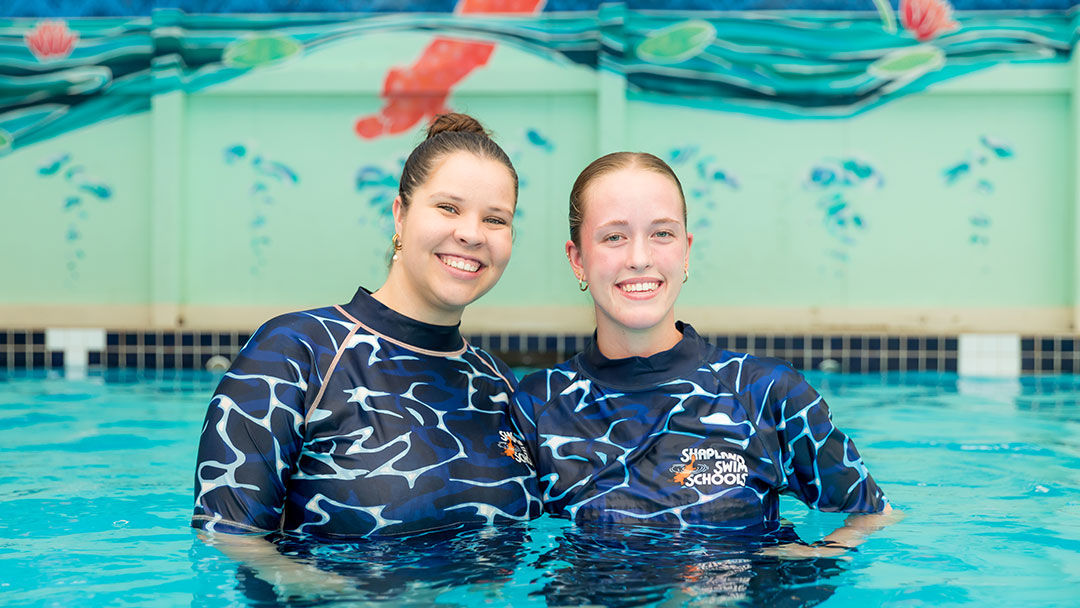
Shaplands swim instructors in the pool
Twenty minutes, fully focused
Shapland’s lessons run for a tightly defined 20 minutes — shorter than many programs and, again, the product of years of observation rather than convenience. Chris and his teachers found that after roughly 20 minutes, children’s concentration reliably begins to drop off. Combined with the small class sizes, which mean far less time spent waiting for a turn, that window is enough for a genuinely productive, engaging lesson without pushing children past the point of real focus.
Learning to swim without goggles
Water safety runs through everything Shapland teaches, and one principle in particular that sits at the heart of the program is that children should be able to swim without goggles.
“We want children to know the sensation of swimming without goggles in the event they were to fall into water without goggles on,” Chris says. In an accidental fall, a child is very unlikely to be wearing goggles, so Shapland’s teachers work to ensure children are genuinely comfortable getting water on their faces, opening their eyes underwater, orienting themselves and using their swimming and water safety skills without relying on equipment they may not have on hand.
That approach reflects Chris’s broader view of what “learning to swim” actually means. A child who can fall in, turn around and paddle back to the side of a familiar pool isn’t necessarily safe in the water more broadly. “Your child may get caught in a current, there might not be a side to reach for, or they may not have the skills to swim to safety,” he says. His benchmark for genuine water competence is considerably higher than the national standard: around 400 metres, or eight laps of a 50-metre pool, by the time a child reaches their early teens.
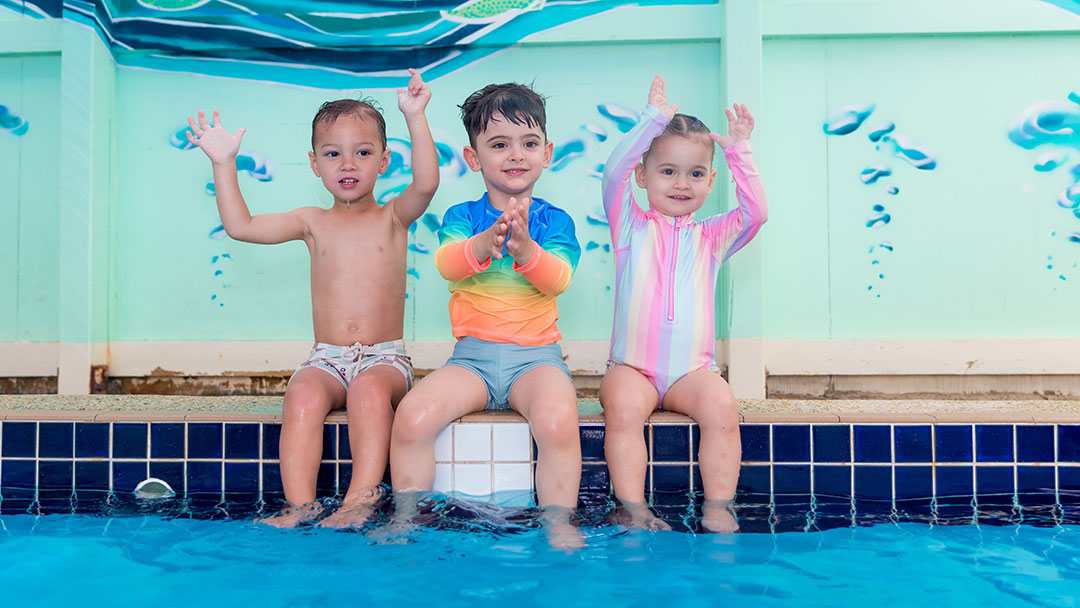
Three young children sitting on the side of the pool ready for a swim lesson
A program that’s never finished
That’s also why Shapland treats swimming as a skill in constant development rather than a box to be ticked. The program moves children from the baby and toddler stages through preschool, school-age and advanced levels, continually adding new strokes, techniques and safety challenges as confidence grows.
“As children move into different aquatic environments, they need different skills to match the environment,” Chris says. “Learning to swim isn’t a task to tick off. Constant skill development and adaptation are required. Our children never ‘finish’ swimming… there is always more to learn.”
And with spring marking the beginning of the warmer months, it’s also a timely reminder that water confidence is built well before summer arrives. Consistent lessons give children the time to develop their skills gradually, helping them head into the summer months with greater confidence and ability in the water.
Growing without changing the formula
The opening of the Redbank Plains school in August 2026 brings Shapland to 16 centres across Southeast Queensland, but Chris is adamant that scale hasn’t diluted the model. The new school was built around the same fundamentals as every other: classes of three, a quiet learning environment, a purpose-built multi-depth pool and warm magnesium mineral water.
None of these features exists in isolation. As Chris sees it, the small classes, the quiet pools, the varying depths, the shorter lessons and the mineral water have all evolved together, out of the same decades-long process of watching what genuinely helps children feel comfortable, stay focused and build real confidence in the water. Shapland isn’t different for the sake of it. It’s different because, over more than eight decades, generations of children in the pool have helped shape what works.