
Swimming progress does not only happen during lessons. What children do between sessions can also influence how comfortable, confident, and motivated they become in the water. Parents do not need to become swimming instructors themselves. Simple, consistent activities can help reinforce what children are learning while making swimming a familiar part of their routine.
For families attending kids swimming lessons, the time between sessions is a chance to practise familiar skills without turning every pool visit into another formal lesson.
Make Water Time Enjoyable
One of the easiest ways to support swimming progress is to make time in the water enjoyable. Children are more likely to participate when swimming feels like something they look forward to rather than a task they have to complete.
During family pool visits, parents can encourage simple activities such as splashing, moving through shallow water, or playing suitable water games. These experiences help children become more comfortable while keeping the focus on enjoyment.
Practise Familiar Skills
Parents should avoid trying to teach techniques that their child has not yet covered with an instructor. Instead, focus on repeating movements and activities the child already knows.
For example, if they have been practising kicking, parents can encourage them to repeat those movements during supervised pool time. Repetition helps children become more familiar with the movement and can make it easier to perform during future lessons.
Encourage Floating and Body Control
Floating is an important foundation for swimming and can be practised during supervised water activities. Parents can encourage children to repeat floating positions they have already been introduced to by their instructor.
The aim is to help children understand how their body behaves in water while becoming more comfortable with maintaining their position. As their confidence improves, they can gradually develop better balance and control.
Reinforce Water Safety
Swimming progress should always go hand in hand with water safety. Parents can reinforce simple rules outside lessons, such as never entering a pool without adult supervision and listening carefully to safety instructions.
It is also important for children to understand that being able to swim does not mean they are safe around water without supervision. Good swimming ability should always be supported by responsible behaviour.
Avoid Comparing Progress
Every child learns swimming skills at a different pace. Comparing one child’s progress with another can create unnecessary pressure and may make swimming less enjoyable.
Instead, parents should focus on individual improvements. A child who was previously nervous about putting their face in the water may have made significant progress simply by becoming more willing to try.
Small milestones can be important steps towards greater confidence.
Celebrate Effort and Improvement
Children can become discouraged if they believe success only means completing a skill perfectly. Parents can help by recognising effort, persistence, and willingness to try.
Acknowledging improvements can encourage children to keep practising, even when a particular skill takes time to master. This positive attitude can make them more willing to participate during future lessons.
Keep Practice Short
Long practice sessions are not necessarily more effective. Young children can lose concentration or become tired quickly, particularly when they are still developing their swimming abilities.
Short periods of supervised practice can be more useful than trying to recreate an entire swimming lesson. Regular opportunities to use familiar skills can help reinforce learning without making swimming feel like a chore.
Support Progress at Every Age
The way parents support swimming development may change as children grow. Younger children may benefit from simple water play and supported movement, while older children can practise more specific skills they have already learned.
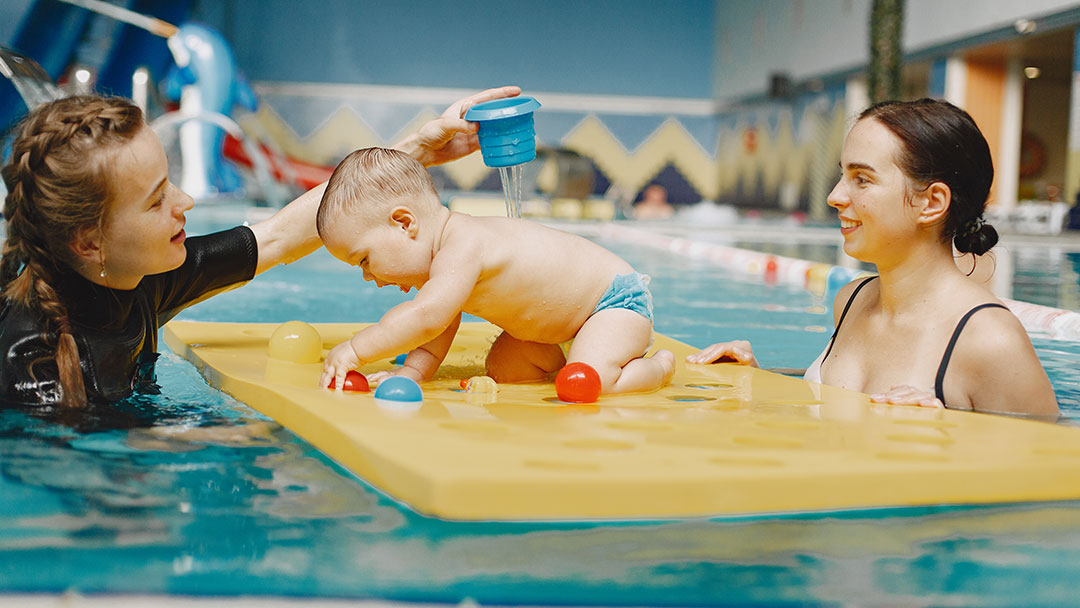
Mother, baby and swim teacher at baby splash and play session
For families starting with baby swim activities, parents can focus on helping their child become familiar with water, movement, and basic water experiences. As children develop, these early experiences can provide a useful foundation for more advanced swimming skills.
Follow the Instructor’s Advice
Parents and swimming instructors should work together. If an instructor recommends particular skills or activities to practise, parents can reinforce them during suitable pool time.
However, parents should avoid changing techniques or introducing advanced exercises without professional guidance. Incorrect practice can create habits that may later need to be corrected.
Keep Children Motivated
Swimming progress can take time, so keeping children interested is important. Parents can talk about what their child enjoyed during lessons, ask about new skills they learned, and celebrate improvements.
Making swimming part of a positive routine can help children stay motivated and develop a lasting interest in the activity.
Final Thoughts
Parents play an important role in supporting swimming progress between lessons, but their role is not to replace the instructor. The most effective approach is to provide safe, supervised opportunities to practise familiar skills while keeping swimming enjoyable.
By reinforcing water safety, encouraging effort, following professional guidance, and giving children time to develop at their own pace, parents can help turn lessons into lasting skills and greater confidence in the water.