When young children separate from their family for the first time, they often feel anxious or upset as they settle in. This reaction is completely normal — but how can early learning environments actively support children and help reduce separation anxiety?
Three areas can affect a child’s level of anxiety in the learning environment:
- Group numbers
- Room size
- Play space size.
Young children need smaller class numbers to alleviate separation anxiety
Research has found that young children can become unsettled and anxious if there are too many other young children in a room. At this stage of your child’s development, they are not used to being part of a large group of similar-aged children. If too many people are physically close to your child for extended periods of time, they might find it more challenging to regulate their feelings.
Smaller class sizes have several benefits for young children. The lower child numbers create better staff-child ratios. With smaller class numbers and fewer children per teacher, children have greater opportunities to interact with adults. They also receive more individual attention, which can, in turn, increase their learning ability.
Educators play a vital role in building strong, meaningful relationships with young children. Warm, caring, unhurried and responsive interactions help children feel safe and secure — but when group sizes are too large, this becomes harder to achieve, and separation anxiety can be heightened.
For example, Out & About Care & Education purposefully keeps its group sizes to a sensible and age-appropriate number. This allows children to learn and navigate the environment around them without additional ‘crowd-related’ and ‘reduced adult’ connection stress.
The indoor environment
Room size plays an important part in how your child learns. The indoor environment in an early childhood setting should create an atmosphere that is welcoming, inviting and engaging for young children. Rooms that are of minimal size can be difficult for young children to navigate. This can increase their stress, anxiety and frustration.
If your child bumps into other children accidentally, for example, they might become upset, they may feel crowded. Their agitation level rises and usually this results in tears and upset.
A larger-than-required classroom can positively support your child’s growth and development. It gives early childhood educators more space to observe, engage with and respond to children in meaningful ways. With room to move, explore and focus, children are also better supported to work towards and achieve their learning goals.
Things you should look for when it comes to room size:
- Large spaces broken up with smaller defined areas encourage children to move at a reasonable pace in the room
- Tables, chairs, shelves and mats that are placed strategically to define key areas of play or activity, and also boundaries for children
- Materials that are displayed in an inviting way.
Creating perfect play spaces
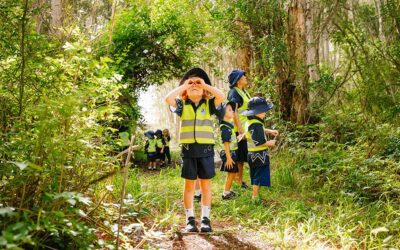
Out & About Care & Education offers green, generously sized outdoor play spaces, many with calming water views or other relaxing natural outlooks. These thoughtfully designed environments support children’s wellbeing and encourage relaxed, confident play.
Children’s learning experiences are enhanced by their interaction and engagement with the environment and people around them. Children are more relaxed and open to learning in environments where they don’t have to worry about their proximity to others.
The way a learning environment is designed and used — from the layout of the space to the choice of equipment and materials — plays a powerful role in shaping a child’s learning. A well-considered indoor environment should foster a sense of belonging, offer meaningful stimulation tailored to each child’s needs and interests, provide security, and allow plenty of space for children to move freely and confidently.
As your child settles into the new environment and relaxes more, they make friends and establish wonderful relationships with their peers and educators.
When the size and design of learning spaces are considered, children are better supported across all areas of early learning and development. The conclusion is clear: when it comes to early learning environments, size really does matter.
Servicing Brisbane, Gold Coast, Sunshine Coast and beyond, Kids on the Coast is an online guide for parents. With kids events and activities, attractions & things to do with kids, schools and education, school holiday guides, health & wellbeing for families, parenting and lifestyle news. Located on Gold Coast, Sunshine Coast & Brisbane, QLD.