Before children learn their letters. Before they count to ten. Before they write their name. They learn one thing first: Do I feel safe here? The right early learning environment makes all the difference in that process.
For many Gold Coast parents, enrolling in early learning is both practical and deeply emotional. It’s about returning to work, managing busy routines and thinking ahead to the school years. But beneath the logistics sits something far more instinctive — the need to know your child feels secure, understood and genuinely welcomed.
In the early years, belonging isn’t sentimental. It’s neurological.
From birth to five, children’s brains are developing at a pace that will never be repeated. Neural pathways form in response to consistent relationships, predictable routines and environments that feel emotionally safe. When children feel connected, their capacity to explore expands. Their stress responses reduce. Their curiosity grows.
Confidence grows from connection. And connection grows from belonging.
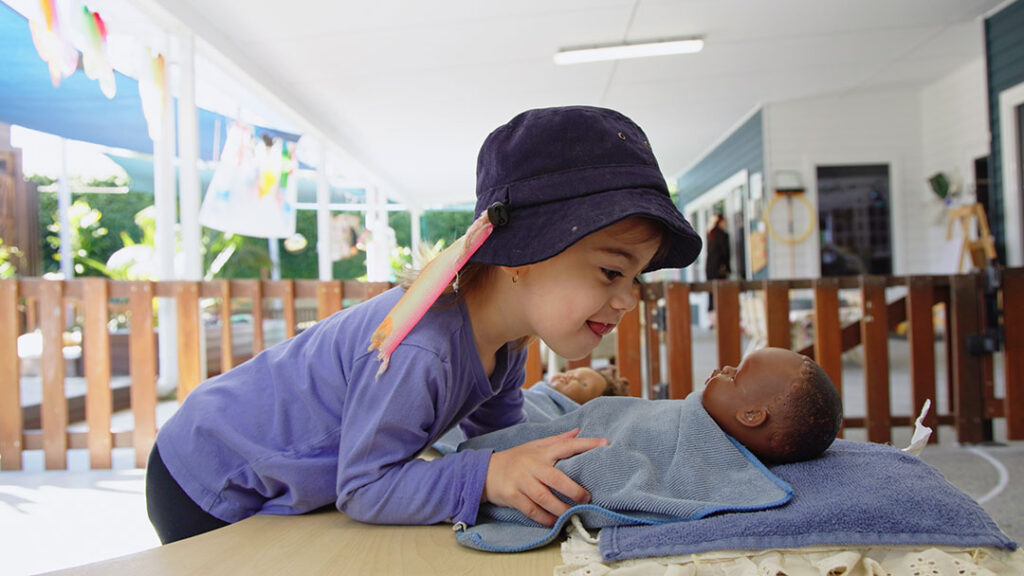
Child playing in home corner at Sanctuary Early Learning Adventure, Ashmore
Early learning environment as the ‘third teacher’
In early childhood education, there is a philosophy often described as the early learning environment being the “third teacher.” The idea, drawn from the Reggio Emilia Approach, suggests children are learning not only from parents and educators, but from the spaces they move through every day.
A room can invite curiosity, or overwhelm it. It can encourage independence, or quietly limit it.
Children read environments instinctively. A calm space with defined learning areas supports emotional regulation. Natural light and access to outdoor play promote wellbeing. Open-ended materials encourage problem-solving and creativity. Protected spaces allow children to reset. Educators positioned at eye level communicate partnership rather than authority.
When environments are intentional, children settle more quickly. They move with confidence. They attempt new challenges because they feel anchored.
Across Sanctuary Early Learning Adventure’s Gold Coast centres — in Ashmore, Maudsland and within the Health & Knowledge Precinct in Southport — the environment is designed with belonging in mind.
Ashmore blends warmth with expansive outdoor play that fosters independence through movement and connection. Maudsland offers open, adventure-inspired spaces that encourage confidence and resilience. Southport’s purpose-built centre reflects contemporary urban design — structured yet nurturing, vertical yet connected — thoughtfully integrated within a thriving community precinct. Different settings. One shared intention: creating spaces where children feel they belong.
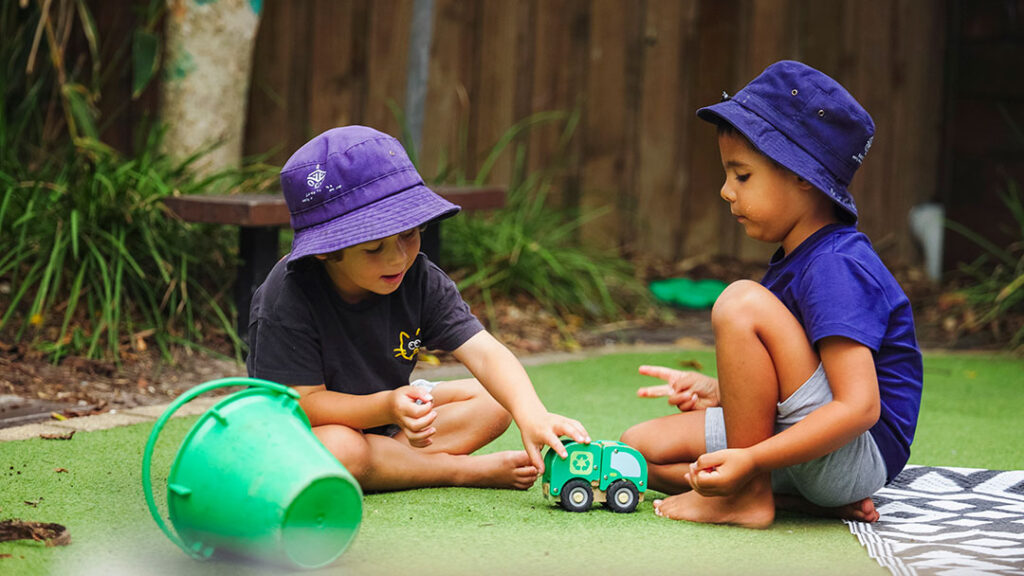
Kids playing at Sanctuary Early Learning Adventure
Belonging builds more than happiness
When parents ask about school readiness, conversations often focus on literacy and numeracy. But true readiness is emotional before it is academic.
Children who feel secure in their early learning environment are more likely to:
- Navigate friendships confidently
- Persist through challenge
- Regulate big emotions
- Advocate for themselves
- Adapt smoothly to new routines
These capabilities are developed through consistent educator relationships and stable leadership — elements that may not always be obvious during a brief tour, but which shape a child’s daily experience.
Familiar faces matter.
Leadership longevity matters.
Culture continuity matters.
Children thrive in environments where adults are calm, present and committed long term. When educators know families deeply — their routines, preferences and personalities — children sense that continuity. It builds trust and trust builds courage.
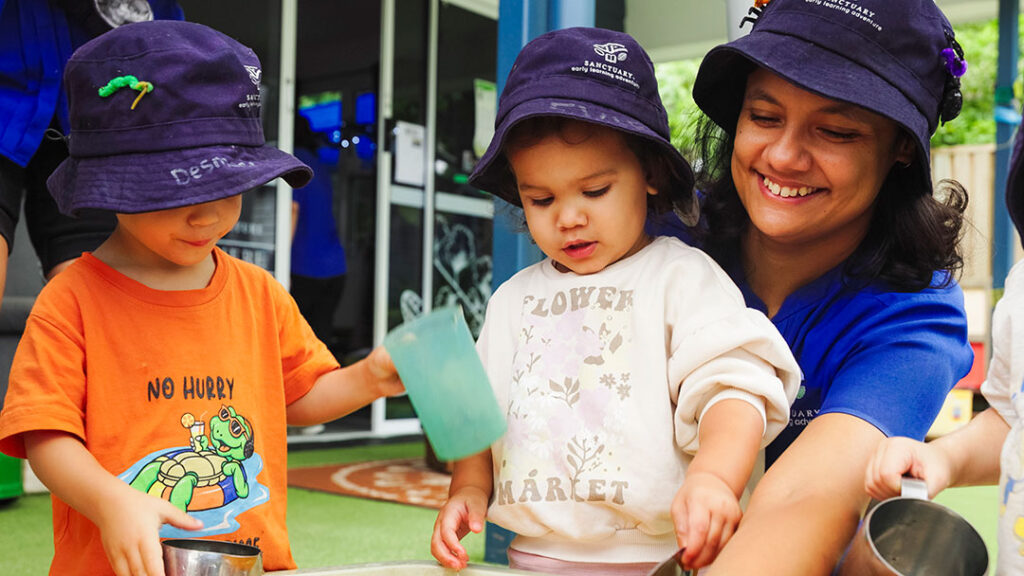
Early Learning educator plays with kids in the water
Belonging beyond the classroom
Belonging also extends beyond the classroom. Gold Coast families increasingly seek early learning environments that feel like an extension of home: places where communication is open, Leadership Teams are visible and conversations are authentic rather than transactional.
When families feel known, their confidence grows too.
- Drop-offs become smoother.
- Transitions feel less overwhelming.
- Partnership strengthens.
- And children sense that alignment between home and care.
- Early learning, at its best, becomes community, not simply supervision.
When visiting centres, trust your instinct, but observe carefully.
- Do children move freely and confidently through the space?
- Are educators attuned to children at eye level, listening as much as guiding?
- Does the environment feel calm, even during busy moments?
- Is leadership present and approachable?
Notice how your child responds. Children often tell us more through body language than words.
Belonging is rarely announced. It is felt.
And when it is present, learning flows naturally.
Early learning is not simply preparation for school. It is preparation for identity.
Before children master literacy, they form beliefs about who they are.
Before they solve problems, they learn whether it’s safe to make a mistake.
Before they write their name, they decide if their voice matters.
Those beliefs are shaped by relationships.
They are shaped by the early learning environment.
They are shaped by belonging.
For Gold Coast families navigating one of the most significant early parenting decisions, perhaps the most powerful question is not, “What will my child learn here?” But rather: “Who will my child become here?”
Because learning follows belonging … every time.
Visit sanctuarylearning.com.au or call 1300 00 PLAY to find out more about Sanctuary Early Learning Adventure and book a tour.
More about Sanctuary Early Learning Adventure
Building a village around every child at Sanctuary Early Learning Adventure Ashmore
The journey to ‘Exceeding’ with Sanctuary Early Learning Adventure