The virtual evolution of schooling: Blending academic rigour, pastoral care and flexibility, this structured virtual learning model challenges everything we thought we knew about school.
In an era where education is rapidly evolving, families are seeking learning environments that are both rigorous and responsive. The rise of structured virtual schooling has provided a powerful alternative to traditional classrooms and unstructured home education. At the forefront of this movement is the Virtual Learning Community (VLC) at Hillcrest Christian College — a model that blends academic excellence, pastoral care, flexibility and community in a way that is uniquely positioned for today’s learners.
Virtual learning as a structured alternative to homeschooling
Homeschooling has grown significantly in recent years, often driven by families seeking flexibility, safety, or personalised pacing. While homeschooling can offer freedom, it also places immense responsibility on parents to design curriculum, manage compliance, ensure academic rigour, and facilitate social development. For many families, this becomes a full-time commitment.
The Virtual Learning Community provides the flexibility families seek, without sacrificing structure, accountability or recognised qualifications.
Students in the VLC remain enrolled in a fully accredited school. They follow a structured curriculum aligned with Australian standards, are taught by qualified teachers, and receive formal assessment, reporting and feedback. This ensures that learning pathways remain clear and future-focused, whether they involve university entrance, vocational pathways, or specialist programs.
Unlike homeschooling, where parents often carry the burden of instruction, the VLC offers professional teaching, subject expertise, and coordinated support. Parents remain partners in their child’s education — but they are not left to carry it alone.
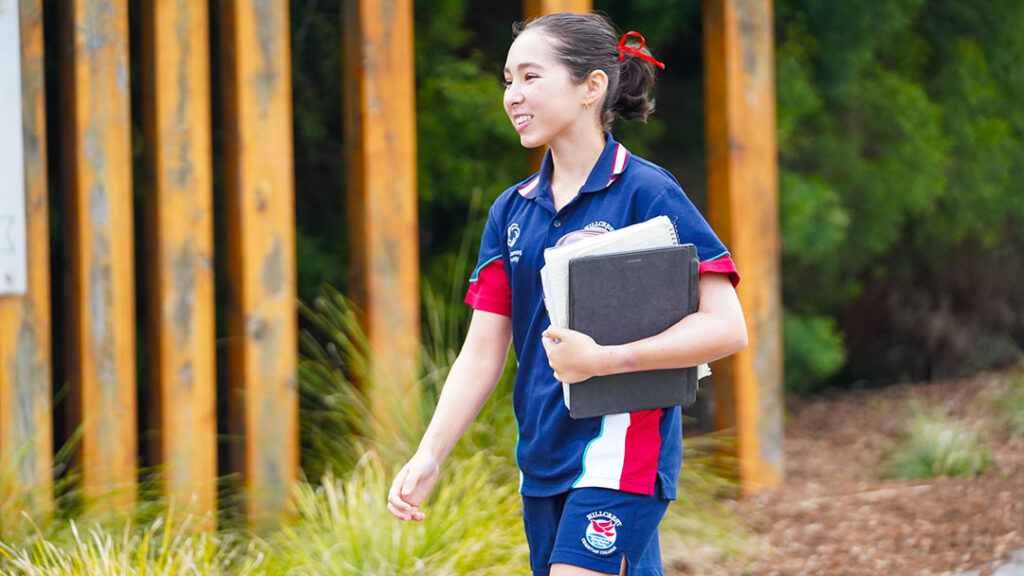
Student at Hillcrest Christian College, part of the Virtual Learning Community
Flexibility without compromise
One of the most compelling strengths of the Virtual Learning Community is flexibility without academic compromise.
Gifted and talented students often face a paradox in traditional schooling. They may excel academically, artistically or athletically, yet find themselves constrained by rigid timetables and attendance requirements. Training schedules, competitions, rehearsals and travel commitments can conflict with fixed school hours.
The VLC removes this friction.
Students can access lessons online, engage in structured coursework, and complete assessments while maintaining elite training or performance commitments. For high-performing athletes competing at state or national level, performing artists touring or rehearsing, or academically advanced students pursuing extension opportunities, the VLC enables balance.
Rather than choosing between excellence in school and excellence in their passion, students can pursue both.
This flexibility does not dilute expectations. Academic standards remain high. Teachers provide real-time instruction, structured modules, and ongoing feedback. Students develop time management, independence and self-regulation — skills that are essential for university and career success.
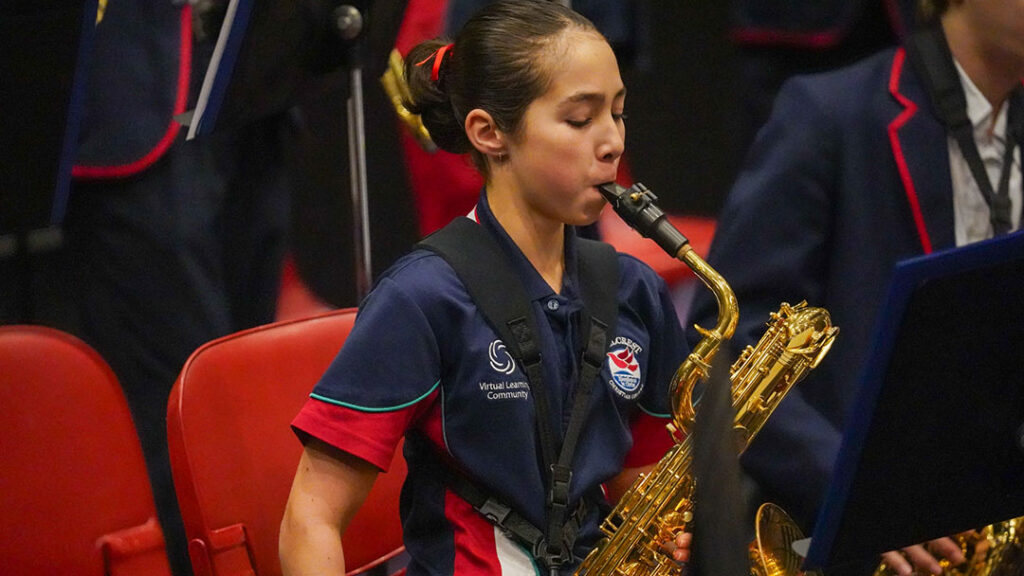
Virtual Learning students have access to extracurricular programs
Meeting the unique needs of a gifted learner
Gifted and talented students often require a learning environment that is both accelerated and adaptive. In traditional classrooms, these learners may experience boredom, disengagement or under-stimulation if content pacing does not match their capability.
The Virtual Learning Community allows for differentiated learning pathways. Students can progress at an appropriate pace, revisit content when necessary, and extend beyond standard curriculum expectations. The digital environment also provides access to a wider range of enrichment opportunities and subject offerings that may not always be available in smaller on-campus settings.
Importantly, gifted students often have asynchronous development — excelling cognitively while navigating emotional or social complexities. A flexible online model can reduce unnecessary stressors while preserving connection through intentional pastoral care and structured community engagement.
The VLC model recognises that high ability does not eliminate the need for support. Rather, it requires thoughtful scaffolding to ensure potential is fully realised.
Community matters
A common misconception about online education is that it lacks community. The Virtual Learning Community challenges this assumption.
Students engage in live sessions, collaborative projects and teacher-led discussions. They remain connected to a broader school identity and culture. Pastoral care structures, wellbeing support and leadership opportunities are intentionally integrated.
Unlike independent homeschooling, where social engagement may rely on external networks, VLC students are part of a defined, supported and values-driven community.
This connection is particularly important for adolescents, who require a sense of belonging as much as academic instruction.
Supporting students experiencing school refusal
Perhaps one of the most powerful contributions of the Virtual Learning Community is its capacity to support students experiencing school refusal.
School refusal is a complex and growing concern across Australia. It may be linked to anxiety, bullying, sensory overload, social challenges, learning differences, or mental health struggles. For these students, the traditional school environment, with its crowded corridors, rigid schedules and high stimulation, can become overwhelming.
When attendance becomes inconsistent, learning gaps widen. Confidence declines. Families feel isolated and unsure of the next step.
The VLC provides a dignified, structured alternative. Rather than disengaging from formal education altogether, students can continue their learning in a psychologically safe environment. Lessons are accessible from home. Expectations remain clear but manageable. Teachers maintain connection. Progress is monitored. Goals are set collaboratively.
This continuity is critical.
Instead of labelling a student as “non-attending,” the VLC reframes the narrative: the student remains enrolled, engaged and progressing, simply through a different mode of delivery.
Over time, this can restore confidence and re-establish positive learning habits. For some students, the VLC becomes a long-term solution. For others, it acts as a transitional bridge back into on-campus learning when readiness improves.
The key difference between homeschooling and the VLC in cases of school refusal is accountability and professional oversight. Students are not withdrawn into isolation. They remain connected to qualified educators who can monitor wellbeing and academic development.
Families are supported rather than left to navigate complex educational and emotional challenges alone.
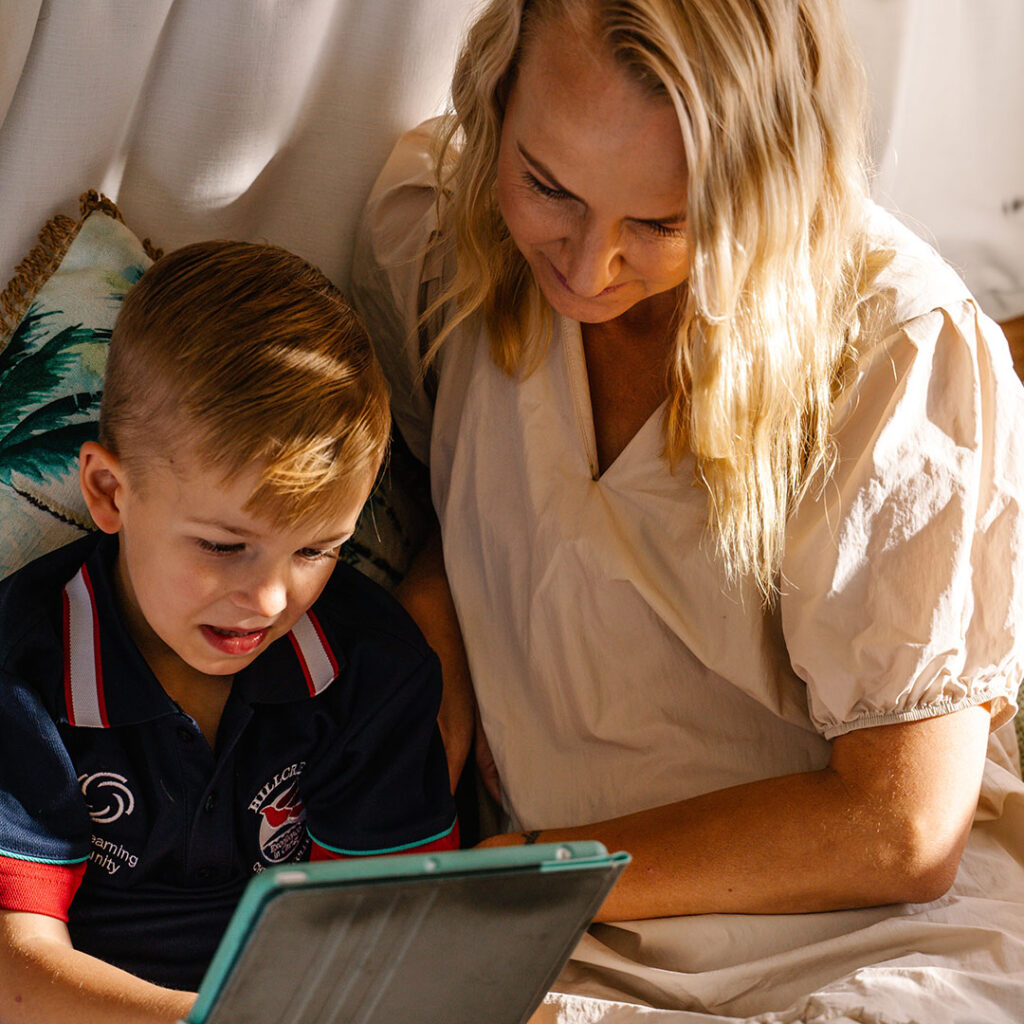
The Hillcrest Virtual Learning Community allows you to study flexibly
A virtual learning model for modern families
For military families, travelling families, high-performance students and those navigating personal challenges, flexibility is no longer a luxury; it is a necessity.
The Virtual Learning Community offers:
- Structured, accredited education
- Qualified teachers and formal reporting
- Flexible scheduling
- Academic rigour
- Pastoral care and wellbeing support
- Community connection
- Pathways to tertiary and vocational futures
It sits between traditional schooling and homeschooling, capturing the strengths of both while mitigating their limitations.
Families are not forced to choose between structure and freedom. They are offered both.
Preparing students for a digital future
The modern workforce is increasingly digital, flexible and globally connected. Universities now integrate online learning platforms as standard practice. Remote collaboration is commonplace across industries.
Students in the Virtual Learning Community develop digital literacy, self-management and communication skills that align with this evolving landscape. They learn to navigate online platforms responsibly, participate in virtual discussions, manage deadlines and engage independently with content.
These competencies are not incidental; they are essential.
The future of education
Education is not one-size-fits-all. The traditional model serves many students well, but it does not serve all students equally.
The Virtual Learning Community represents a thoughtful response to this reality. It recognises diversity in learning styles, life circumstances and aspirations. It affirms that excellence can take many forms — academic, athletic, artistic or personal — and that education should support the whole student.
In a world that demands adaptability, resilience and innovation, the VLC provides a learning model that mirrors those very qualities.
For gifted and talented students seeking flexibility, for families considering alternatives to homeschooling, and for young people navigating school refusal, the Virtual Learning Community is not a compromise.
It is a carefully designed, compassionate model of learning, equipping students with the skills, resilience and confidence to thrive in the world ahead.
More about Hillcrest Christian College…
Virtual learning is the way forward for Hillcrest
Think the middle years of school aren’t important? Think again!